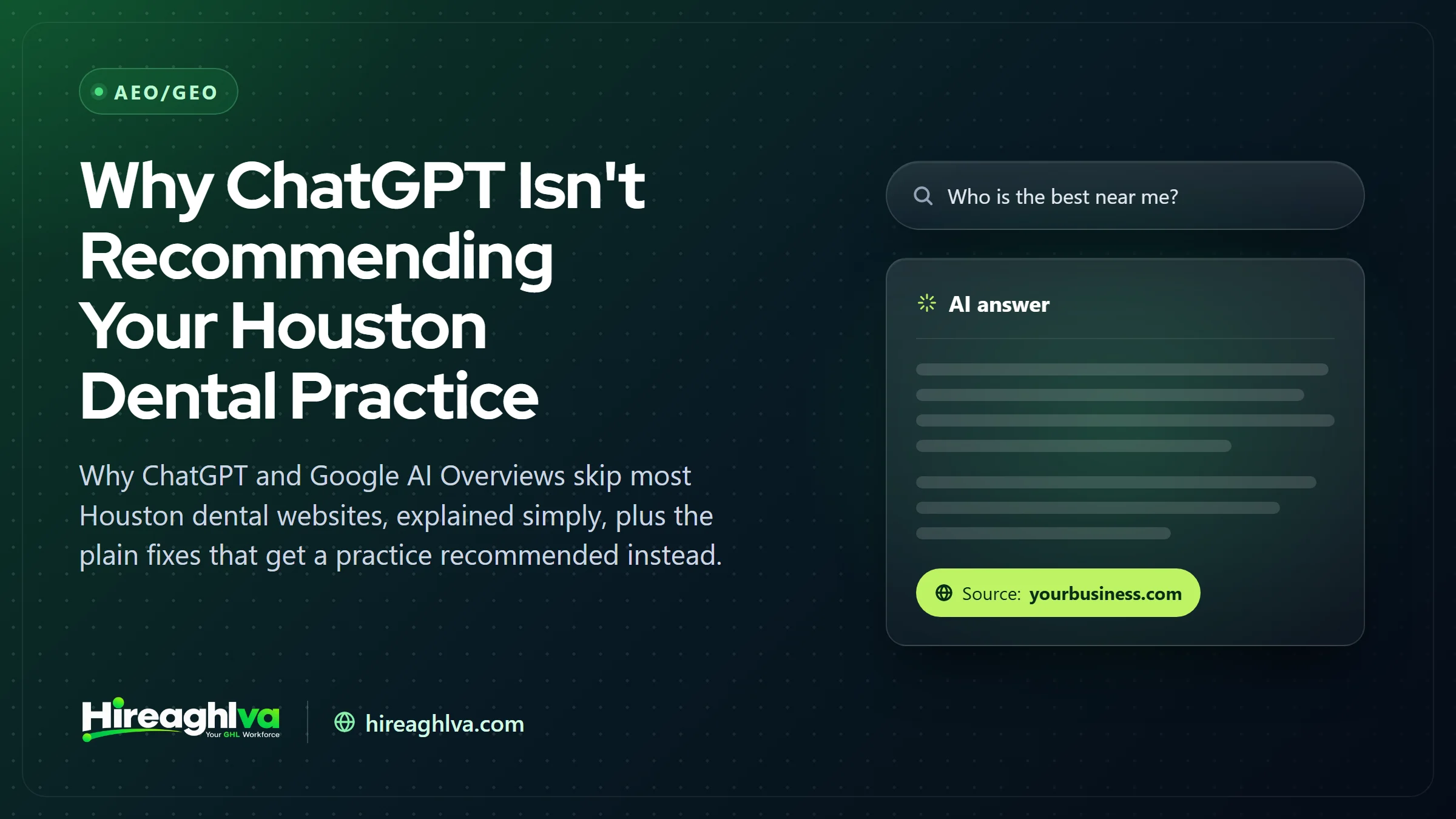
A growing number of people looking for a dentist in Houston aren’t starting on Google anymore — they’re asking ChatGPT. 45% of people now ask AI tools for local recommendations, up from just 6% a year earlier. If your website doesn’t give an AI tool something clear and specific to say about your practice, it’ll simply recommend someone else instead — and you’ll never even know you were passed over.
In plain numbers: 45% of people now ask AI tools like ChatGPT for local business recommendations, up from 6% a year ago (BrightLocal, 2026 Local Consumer Review Survey). Separately, a Gallup survey found 25% of U.S. adults have used an AI tool for health questions — and of those, 59% do it before ever seeing a doctor or dentist (Gallup, 2026). Dental practices ranking in Google’s top 10 get named by AI assistants 82% of the time, versus just 47% for practices ranking just outside the top 10 (Identity Dental Marketing, 2026 Visibility Report).
Here’s the plain version: imagine someone new to Houston asks ChatGPT, “what’s a good dentist near the Heights?” ChatGPT answers using whatever it can find that’s clear and specific — actual services, actual details, real answers to real questions. If your website is full of vague phrases like “comprehensive, personalized dental care,” there’s nothing there for it to repeat. So it recommends the practice down the street that actually spelled things out.
Why this matters even more in Houston
Houston is a huge, spread-out city with heavy competition among dental practices, which makes this specific problem worse:
- It’s a big metro with dozens of neighborhoods. People search by area — “dentist in Sugar Land,” “dentist near The Woodlands” — and an AI tool needs your website to clearly say where you actually are and who you serve.
- There’s no shortage of other dental practices to recommend instead. A vague website doesn’t just rank lower — it gets skipped entirely in favor of a competitor’s site that actually answered the question.
- A fast-growing, tech-comfortable population is exactly the group most likely to ask ChatGPT a question like this instead of scrolling through search results the old way.
What’s actually happening here
45%
Of people now ask AI tools for local recommendations (up from 6%)
25%
Of U.S. adults have used AI tools for health questions
900M
Weekly ChatGPT users worldwide
| Item | Value |
|---|---|
| Practices just outside Google's top 10 | 47% |
| Practices in Google's top 10 | 82% |
Source: Identity Dental Marketing, 2026 Visibility Report
These are broad industry figures, not a Houston-specific study — treat the exact percentages as directional. The clear pattern across every study on this topic: showing up in an AI recommendation and ranking well on Google tend to go together, not compete with each other.
What actually makes ChatGPT recommend a dental practice?
In plain terms, AI tools recommend websites that give them something specific and true to repeat. Here’s what that means for a dental practice:
- Say exactly what you offer, in plain language. Not “advanced restorative solutions” — “we offer fillings, root canals, and dental crowns,” with a real page for each.
- Answer the questions patients actually type. “Does it hurt to get a filling,” “how much does a cleaning cost,” “do you take my insurance” — written as direct, honest answers, not buried in a PDF.
- Add the hidden “label” that tells computers what your page is about — this is what’s called schema markup. Think of it as a clearly labeled index card behind your webpage: your practice name, services, hours, and reviews, all spelled out in a format a computer reads directly instead of guessing.
- Build the site so it loads fast and shows its content right away, not after a bunch of extra code finishes loading — some AI tools simply won’t wait around, and if the content isn’t there immediately, they move on to a competitor’s site instead. This is the same reason a lightweight, Astro-built site tends to out-rank a heavier WordPress build, covered in more depth in our Astro vs. WordPress comparison.
Websites AI tools recommend vs. websites they skip
Says exactly what services are offered, with real detail
- Gets recommended
- Gets skipped
Answers real patient questions directly
- Gets recommended
- Gets skipped
Has the hidden "labels" (schema) computers can read
- Gets recommended
- Gets skipped
Loads fast, with content visible right away
- Gets recommended
- Gets skipped
Uses vague marketing phrases instead of specifics
- Gets recommended
- Gets skipped
| Gets recommended | Gets skipped | |
|---|---|---|
| Says exactly what services are offered, with real detail | ||
| Answers real patient questions directly | ||
| Has the hidden "labels" (schema) computers can read | ||
| Loads fast, with content visible right away | ||
| Uses vague marketing phrases instead of specifics |
Keeping it working — a simple upkeep routine
This isn’t a one-time fix — a website that was clear and accurate when it launched can drift out of date, and an AI tool repeating outdated information is worse than not being mentioned at all.
A simple routine for staying recommended by AI tools
| How often | What to check | Why it matters |
|---|---|---|
| Monthly | Are prices and services on your top pages still accurate? | An AI tool repeating an old price makes a bad first impression |
| Every few months | Ask ChatGPT a few real patient questions yourself | Shows you exactly what it's currently saying about your practice |
| Any time something changes | Update the page the same week | AI tools only know what your website currently says |
What you actually get
Cutting past the technical explanation, here’s what this actually means for your practice:
- You show up when someone asks an AI tool for a dentist in your part of Houston — instead of losing that patient to a competitor before they ever see your name.
- New patients arrive already knowing what you offer and roughly what it costs, because that’s exactly the information the AI tool pulled from your site and told them.
- Your site keeps working for regular Google search too — every fix here is also a plain SEO improvement, so you’re not choosing between the two.
- The site loads fast on a phone, which matters directly to patients, not just AI tools — most people searching for a dentist are doing it on their phone, often in a hurry.
- You stop guessing whether AI search matters for a dental practice, and start actually showing up in it.
Bringing it together
Being recommended by ChatGPT isn’t some separate, futuristic marketing channel — it’s mostly a byproduct of having a clear, specific, fast website, which is exactly what’s always mattered for a dental practice online. A Houston practice that replaces vague copy with real answers, adds the hidden labels computers can read, and builds on a genuinely fast site is positioning itself to show up both in AI answers and regular search — not one or the other. Our AEO/GEO explainer covers the same ideas in more depth if you want the fuller picture, and website package pricing starts at $97 a month if you’d rather have this built for you.
Written by the Hireaghlva GoHighLevel team
We build and run GoHighLevel accounts, automations, dashboards, and websites for agencies and local businesses across the US and Canada. This guide reflects that hands-on work, with sources cited inline where we reference outside data.