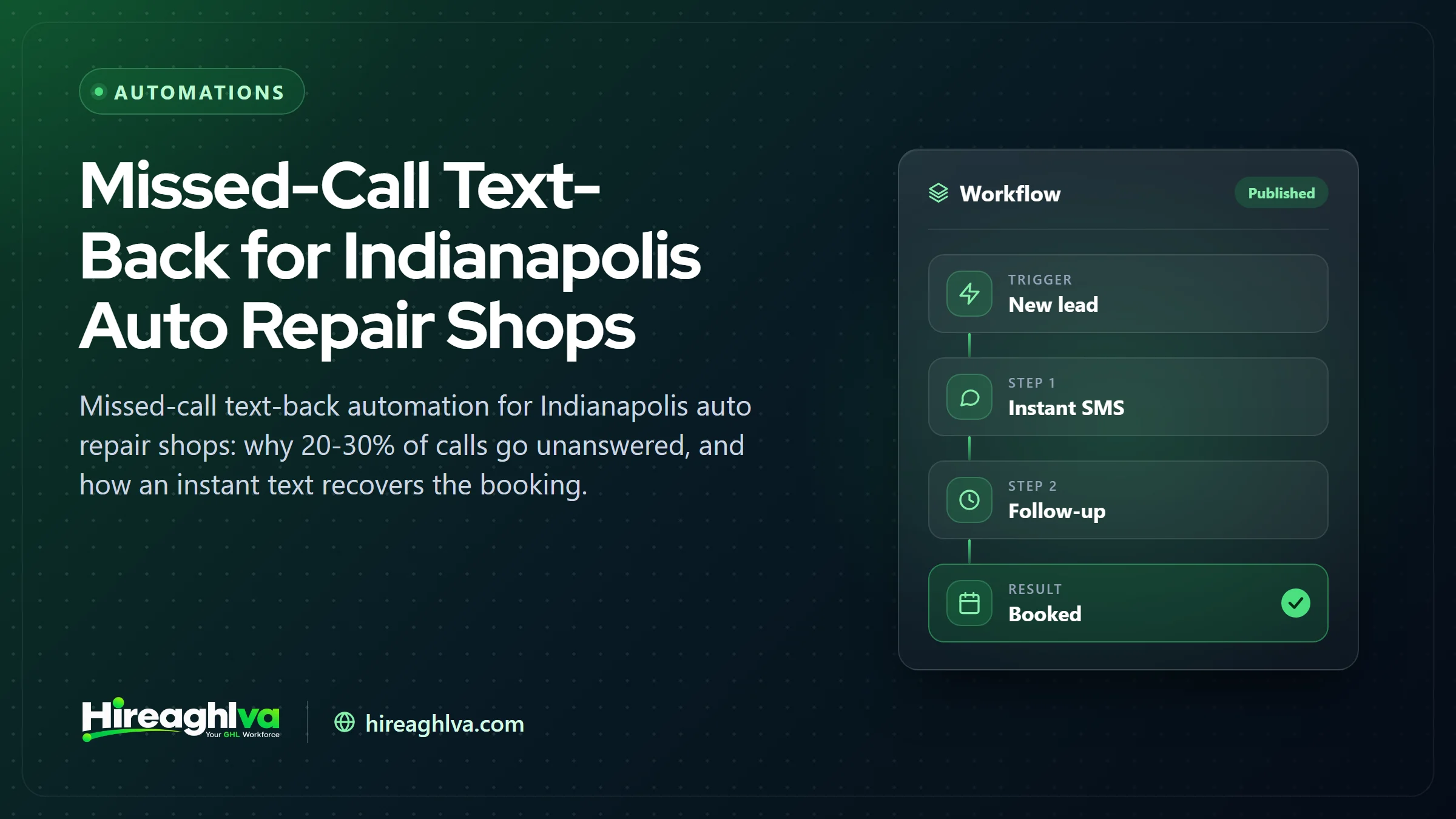
An Indianapolis auto repair shop that misses a call doesn’t have to lose the customer entirely — a missed-call text-back automation catches it within seconds, before the caller has dialed the next shop. Shops miss an estimated 20-30% of incoming calls, mostly because a technician with grease on their hands can’t drop a job to answer. A text-back doesn’t require anyone to stop working — it fires automatically.
In plain numbers: Auto repair shops miss an estimated 20-30% of inbound calls during business hours (AgentZap, 2026 auto repair phone statistics). At an estimated $428 average repair order, missing five calls a day can mean over $2,100 in lost revenue daily. 53% of independent shops have no online scheduling system and still book by phone, paper, or memory (Ratchet+Wrench/AutoZone, 2026 State of the Market).
Here’s the simple logic: a customer whose call rings out usually assumes nobody’s there and moves on to the next shop in their search results. A text that arrives within seconds — even a short one — signals that someone’s actually paying attention, and gives them an easy way to respond without calling back and hoping for a different result.
Why a missed call costs a repair shop more than it costs most businesses
Several industries can shrug off a missed call and pick it back up tomorrow. Auto repair isn’t one of them, for three overlapping reasons.
The timing is rarely optional. A customer calling about a check-engine light, a grinding brake, or a car that won’t start isn’t browsing — they need the vehicle fixed, usually within a day or two, sometimes within the hour. That urgency cuts both ways: it means a shop that answers first has a real shot at winning the job, but it also means a caller who gets no response has every reason to move on immediately rather than wait for a callback. There’s no “I’ll just try them again tomorrow” in a breakdown, which is exactly why speed matters so much more here than in businesses where a customer is comparing options over a few days.
Declined estimates are a second, quieter leak. A large share of repair revenue doesn’t close on the first visit — it closes on the follow-up after a customer says “let me think about it” to a bigger estimate: a timing belt, brakes all around, a transmission service. Most shops have no structured way to come back to that customer a few days later with a reminder and a reason to say yes. The estimate sits in a drawer or a shop management system, untouched, and the repair either never happens at all or happens somewhere else once the customer finally gets around to dealing with it. Speed and consistency matter here just as much as they do on the first call — the same principle covered in our broader speed-to-lead automation guide.
Comparison shopping is the norm, not the exception. Very few first-time callers to a repair shop have already decided to book. They’re calling two or three shops, reading reviews between calls, and going with whichever one actually picks up, responds fastest, or seems most on top of things. A missed call doesn’t just lose that one interaction — it actively pushes the customer toward a competitor’s number, which they already have open on their phone screen from the search results they were just looking at.
Put together, these three dynamics mean a repair shop’s phone and follow-up habits are doing a lot more revenue-protecting work than they typically get credit for. At the estimated $428 average repair order cited above, a shop doesn’t need many recovered calls or converted estimates in a month before the automation has clearly paid for itself — the harder number to see is the one that never shows up anywhere, the customer who simply never called back and whose business went to whichever shop did answer.
Over months and years, this compounds in a way that’s easy to underestimate. A shop that answers fast and follows up consistently builds a reputation for being responsive — the kind of thing that shows up in reviews (“they called me right back”) and in referrals from customers who noticed. A shop that doesn’t builds the opposite reputation just as reliably, even when the actual repair work is every bit as good. Fixing the response gap isn’t only about the revenue from this week’s missed calls; it’s about which reputation compounds over the life of the business.
Why this matters especially in Indianapolis
Indianapolis is a central Midwest hub with strong demand for local services, which creates a specific opportunity for shops that fix this gap early:
- A market with real competitive density. Between independent shops and dealership service centers, a customer whose call goes unanswered has plenty of other options close by.
- A car-dependent population with steady repair demand. Consistent volume means missed calls aren’t a rare event — they’re a predictable, recurring leak worth fixing once rather than absorbing every week.
- Less flashy but reliable market growth. A shop that fixes basic response gaps early has room to build a real reputation advantage before competitors catch up.
20–30%
Of inbound calls go unanswered at the average shop
$428
Estimated average repair order — what a missed call can be worth
53%
Of shops still book by phone, paper, or memory
| Item | Value |
|---|---|
| 3 missed calls/day (avg $428 repair order) | 1284 |
| 5 missed calls/day (avg $428 repair order) | 2140 |
Source: AgentZap, 2026 auto repair phone statistics
These figures assume every missed call represents a real repair order, which won’t be true 100% of the time — treat them as directional, not exact. Even accounting for wrong numbers and general inquiries, the research consistently finds a meaningful share of missed calls are genuine business.
Indianapolis: the “Crossroads of America,” and what that means for repair demand
Indianapolis didn’t earn the nickname “Crossroads of America” by accident. Few U.S. metros have this many major interstates converging in one place: I-65, I-70, I-69, and I-74 all pass directly through or immediately around the city, putting Indianapolis at the literal intersection of north-south and east-west freight and commuter traffic for a huge swath of the Midwest. That convergence has a direct, durable effect on demand for auto repair — a city built around that much highway traffic sees a correspondingly high volume of vehicle-miles traveled, from long-haul freight and regional fleets passing through to the ordinary commuters who drive farther, on average, because the metro sprawls outward from that same highway grid.
More miles driven means more wear — more brake jobs, more tire replacements, more fluid services, more of the general maintenance volume that keeps a repair shop’s bay schedule full. It also means a meaningful share of a shop’s potential customers aren’t just local regulars; they’re commuters from Carmel, Fishers, Greenwood, and the other suburbs who drive significant daily mileage on those same interstates, plus fleet and logistics-adjacent vehicles that need fast turnaround because downtime costs their owner money well beyond just the repair bill.
The competitive landscape is genuinely crowded. Indianapolis has a deep bench of independent shops with decades of local reputation, alongside a heavy presence of national chains — Firestone, Midas, Meineke, Christian Brothers, and dealership service departments among them — all competing for the same pool of drivers. That density is exactly why response speed and follow-up consistency matter more here than in a smaller, less competitive market: when a customer has five or six credible options within a short drive, the shop that actually answers the phone — or texts back fast when it can’t — has a real edge that has nothing to do with the quality of the repair work itself.
The city’s identity is also genuinely car-centric in a way that shapes the local customer base. Indianapolis is home to the Indianapolis Motor Speedway and the Indianapolis 500, one of the most recognizable events in motorsports, and that racing culture runs deeper than one race weekend a year — it’s tied into a broader regional enthusiasm for cars, performance, and craftsmanship that shows up in car shows, enthusiast communities, and a customer base that, on average, tends to know more about their vehicles and care more about who’s working on them than a less car-engaged market might. For an independent shop, that’s an advantage worth leaning into: a customer base that already values automotive expertise responds well to a shop that demonstrates it’s organized, responsive, and easy to deal with — not just competent under the hood.
The climate adds its own steady stream of demand on top of all of this. Central Indiana winters bring road salt, freeze-thaw cycles, and pothole season every spring, all of which accelerate wear on brakes, suspension components, alignment, and the battery and cooling systems that get stressed hardest by temperature swings. That’s not a one-time event — it’s a predictable, recurring part of the calendar that gives a well-timed service reminder (ahead of winter for batteries and antifreeze, after the spring thaw for alignments and tires) a real reason to land exactly when a customer is already thinking about it, rather than competing for attention at a random point in the year.
What a missed-call text-back automation actually does
A missed call, before and after text-back automation
| Moment | Without automation | With missed-call text-back |
|---|---|---|
| Call rings out unanswered | Nothing happens — customer assumes no one's there | A text goes out within seconds |
| Customer wants to book a service | Has to call back and hope for a different result | Can reply to the text with a booking link |
| Customer has an urgent question | Same as any missed call | Gets shop hours, address, and a way to respond immediately |
| Shop owner reviews performance | No idea how many calls were actually missed | Every missed call and text reply is logged |
Text-back vs. a full AI receptionist vs. nothing
Acknowledges a missed call automatically
- Missed-call text-back
- Full AI receptionist
- Nothing
Can hold a full conversation and book live
- Missed-call text-back
- Full AI receptionist
- Nothing
Setup cost and complexity
- Missed-call text-back
- Low
- Full AI receptionist
- Moderate
- Nothing
- None
Good starting point before adding voice AI
- Missed-call text-back
- Full AI receptionist
- Nothing
| Missed-call text-back | Full AI receptionist | Nothing | |
|---|---|---|---|
| Acknowledges a missed call automatically | |||
| Can hold a full conversation and book live | |||
| Setup cost and complexity | Low | Moderate | None |
| Good starting point before adding voice AI |
The four automations that matter most for a repair shop, step by step
Missed-call text-back is the right starting point, but it’s one piece of a larger pattern. Most of the revenue a repair shop loses to poor follow-up falls into four categories, and each one has a specific, fairly simple automation that closes the gap.
1. Missed-call text-back
Covered above, worth restating as a sequence: the phone rings, nobody answers within a set number of rings, and within seconds a text goes out automatically. The message acknowledges the missed call, states what the shop does, and gives the customer a way to respond immediately — either a booking link or an invitation to reply with their question. Anything they reply lands in the shop’s GoHighLevel inbox as a normal two-way text conversation, so a staff member can pick it up the next time they’re free rather than needing to interrupt a repair in progress to call back on the spot. Business-hours logic matters here too — a message sent at 2 a.m. should read differently than one sent at 2 p.m., acknowledging the time and setting expectations for when a human will actually follow up.
2. Declined-estimate follow-up
When a customer gets an estimate and doesn’t approve it on the spot, that estimate should trigger a short automated sequence rather than just sitting in the system. A reasonable version: a text or email the next day asking if they have any questions about the estimate, a second touch three or four days later with a gentle reminder (and, if it fits the shop’s approach, a reason to act — a seasonal push like “before winter” for a battery or belt job), and a final touch after a week or two checking if they’d like to reschedule. None of this requires a phone call from staff unless the customer responds — the system does the reminding, and a person only gets involved once there’s an actual conversation to have. The sequence should stop automatically the moment the customer books, so nobody gets a reminder for work they’ve already scheduled.
3. Service and maintenance reminders by mileage or time interval
These are the reminders that turn a one-time customer into a repeat customer. The automation tracks roughly when a vehicle is due for its next service — either on a fixed interval (every 5,000 or 7,500 miles, for example) or a time-based one (every six months) — and sends a reminder with a direct booking link before the customer has a reason to think about any other shop. Seasonal variants work especially well in a market like Indianapolis: a reminder about tire changeovers or a pre-winter battery and cooling-system check lands right when a Midwest driver is actually thinking about it, which raises response rates compared with a generic “time for service” nudge sent at a random point in the year.
4. Post-pickup review requests
The highest-converting moment to ask for a review is right after the customer picks up their car and pays — while the experience is still fresh and, ideally, positive. An automated text or email goes out within an hour or two of the invoice being marked paid, with a direct link to the shop’s Google Business Profile. Timing and directness matter more than cleverness here: a request sent immediately, with one tap to the review page, consistently outperforms a generic “how did we do?” survey that adds an extra step before the customer can actually leave a review. The best versions of this automation also route differently depending on how the visit went, rather than firing identically for every invoice regardless of whether the visit was smooth or involved a comeback.
What this costs vs. what a lost or delayed customer costs
The math on these automations is straightforward once it’s laid out, which is exactly why it’s worth laying out rather than leaving it as a vague sense that “we should probably get around to this.”
Start with the repair order value already cited above: an estimated average of $428 per repair order. That’s the baseline unit of revenue sitting behind every missed call, every unanswered estimate follow-up, and every customer who quietly drifts to a competitor because nobody reminded them it was time for a service. A shop doesn’t need to recover every missed call or win back every declined estimate to make these automations worthwhile — recovering even a handful of those per week, at that average order value, can cover the cost of the automation build many times over in the first month alone.
Rough monthly math at a single Indianapolis shop (illustrative, based on the estimated $428 average repair order cited above)
| Scenario | Estimated monthly impact |
|---|---|
| Missed calls recovered via text-back (conservative: 1–2/day) | $1,300–$2,600 in recovered repair orders |
| Declined estimates that convert after a follow-up touch (a handful per month) | Varies by shop, often several repair orders worth |
| Repeat visits pulled forward by a service reminder instead of drifting to a competitor | Ongoing — compounds over the life of the customer |
| Cost of the automation build and monthly platform fee | A small fraction of one recovered repair order |
The harder cost to put a number on is the customer who doesn’t come back at all. A repair shop’s real value isn’t one transaction — it’s the customer who keeps coming back for oil changes, brakes, tires, and the occasional bigger job over years of ownership. A single missed call or an unreturned estimate follow-up doesn’t just cost that one repair order; if it’s bad enough to send the customer to a competitor permanently, it costs every future visit that customer would have brought with them. That’s the real reason these automations tend to pay for themselves quickly even though no single missed call feels like a large loss in isolation — it’s the accumulated, compounding version of that loss that actually matters, and it’s especially true for the commuter and fleet-adjacent customers common in a highway-crossroads market like Indianapolis, who tend to need service more often simply because they drive more miles.
A branded dashboard that tracks missed-call recoveries, estimate follow-up conversions, and review volume side by side turns this from a vague sense that “the automations are probably helping” into an actual number a shop owner can point to — which also happens to be useful evidence the next time it’s worth deciding whether to expand the system further. For a broader look at whether the platform behind all of this pencils out, see our full GoHighLevel ROI breakdown.
There’s also a segment of the customer base where this math is even more favorable: small commercial accounts and light fleets. A landscaping crew, a delivery contractor, or a local trades business running a handful of work vehicles can’t afford unplanned downtime the way an individual commuter can tolerate driving a slightly rough car for a week — every vehicle off the road is a vehicle not earning money that day. A shop that reliably answers, follows up on estimates without being chased, and reminds a fleet manager when preventive maintenance is due has a real shot at becoming that account’s default shop, which in a logistics-heavy market like Indianapolis is a meaningfully larger and stickier prize than a single walk-in repair order.
Choosing how to implement this: what to ask, and DIY vs. managed
Once a shop owner decides these automations are worth having, the next decision is who actually builds and maintains them. A few questions are worth asking before committing to either path.
If you’re evaluating a vendor or agency, ask:
- Does this integrate with what we already use? Many shops run a dedicated shop management system (Tekmetric, Shopmonkey, Mitchell 1, or similar) alongside a CRM like GoHighLevel for marketing and customer communication. Ask specifically how the automation reads appointment, estimate, and invoice data — a system that requires someone to manually re-enter information defeats much of the purpose.
- Who owns the account and the data? Make sure the shop — not the agency — owns the GoHighLevel sub-account, the phone number, and the customer data inside it. An agency that won’t hand over account access if the relationship ends is a red flag.
- How is business-hours logic handled? A missed-call text sent at 2 a.m. should read differently than one sent at 2 p.m. — ask whether after-hours messaging is built in or an afterthought.
- Is texting compliance handled correctly? Business text messaging in the U.S. runs through A2P 10DLC registration, and a shop that skips it risks messages getting filtered or blocked by carriers down the line. A competent vendor handles this as part of setup, not as a surprise later.
- What’s the actual timeline to go live? Missed-call text-back is genuinely one of the simpler automations to build and should be live within days, not weeks. A vendor quoting a long timeline for a single automation is either overcomplicating it or padding the engagement.
DIY makes sense for an owner with real downtime, some comfort with workflow-building software, and no urgency to have everything running this month. GoHighLevel’s own template library and snapshot marketplace — covered in our guide to GoHighLevel snapshots — gives a motivated owner a real head start rather than building every workflow from a blank canvas.
Managed implementation makes more sense for the far more common case: an owner who’s already stretched thin running the shop and doesn’t have a free week to learn workflow automation software from scratch, let alone keep it tuned as the business changes. A part-time specialist — whether an agency or a dedicated VA, as covered in our Jacksonville auto repair VA guide — closes that gap for a fraction of the cost of pulling an owner or service manager off the floor to do it themselves.
Common mistakes shops make when automating missed calls and follow-up
A handful of avoidable mistakes show up repeatedly once shops start building these automations themselves or hire someone who hasn’t done this for the auto repair industry specifically before.
- Sending a generic, unbranded text. A message that doesn’t identify the shop by name reads as spam and gets ignored or, worse, reported. Every automated text should clearly say who it’s from in the first line.
- No way to respond without calling back. A text-back message that just says “sorry we missed you, please call again” defeats the purpose — the customer should be able to reply by text and actually get somewhere, including booking directly if there’s a link.
- Treating every missed call the same, regardless of urgency. A breakdown call and a routine oil-change inquiry don’t need identical messaging. Including the shop’s address and hours in the auto-text matters a lot more for a stranded caller than for someone just checking availability.
- Setting it up once and never checking the numbers. The whole value of these automations is that they’re measurable — missed calls, text-back replies, estimate follow-up conversions, reminder-driven bookings. A shop that never looks at those numbers after setup is flying blind on whether the system is actually working.
- Ignoring A2P 10DLC registration. Skipping proper business texting registration risks carrier filtering down the line, sometimes only after a shop has already come to rely on text automation working reliably. It’s a one-time setup step that’s far easier to do right the first time.
- Asking for a review from every customer regardless of how the visit went. An automated review request that fires after a visit involving a comeback repair or a billing dispute can do more harm than good. The better pattern routes review requests to customers whose visit went well and gives a different, lower-key follow-up to anyone whose experience was rockier.
- Letting the automation replace the human touch entirely. These systems are built to catch what would otherwise be dropped, not to replace a real callback or conversation once a customer actually wants one. The best setups make it easy for a staff member to step into the text thread the moment a real conversation is needed.
- Copying a generic template without adjusting it for the shop. A workflow built for a med spa or a law firm doesn’t translate directly to a repair shop’s language, urgency, or booking flow. The wording, timing, and escalation logic all need to be adapted to how a repair shop actually operates, not just relabeled with the shop’s name.
None of these mistakes are hard to avoid once a shop knows to look for them — they’re the kind of thing that’s obvious in hindsight but easy to miss the first time through, which is exactly why it’s worth getting a second set of eyes on the setup before it goes live rather than after a customer complains about a tone-deaf text.
What you actually get
- Fewer calls disappear without a trace. Every missed call gets a response, even if nobody was free to answer live.
- Customers get an easy way to book without calling back. A reply-to-book text link removes a step that otherwise loses some callers entirely.
- You find out how many calls you’re actually missing — a number most shop owners have never measured because it never showed up anywhere before, the same insight covered in our general missed-call text-back guide.
- It’s a lightweight first step. If you later want a full AI receptionist that handles complete conversations, this automation is already most of the way there.
Bringing it together
A shop doesn’t need to overhaul how it answers the phone to stop losing bookings to missed calls — a simple, fast automation that texts back within seconds recovers a meaningful share of them without pulling anyone off a job. Pair it with a fast, easy-to-book auto repair website and a branded dashboard that shows how many bookings it’s actually recovering, and a caller who can’t reach you by phone still has a real path to booking instead of moving on to the next shop.
Written by the Hireaghlva GoHighLevel team
We build and run GoHighLevel accounts, automations, dashboards, and websites for agencies and local businesses across the US and Canada. This guide reflects that hands-on work, with sources cited inline where we reference outside data.