A Charlotte insurance agency doesn’t usually lose a quote request because a competitor had a better rate — it loses because the competitor called back first. Widely-cited research on business lead response puts the average first-response time above 40 hours, and an insurance-specific case study found that only a small fraction of agencies respond within 5 minutes. A speed-to-lead automation fixes the gap between “someone requested a quote” and “an agent actually called them” — the exact window most agencies leave completely unmanaged.
In plain numbers: A frequently-cited Harvard Business Review study of 2,241 firms found an average first-response time of 42 hours, with only 26% responding within the critical 5-minute window — meaning roughly three-quarters missed it. An insurance-specific case study from HawkSoft/AgencyZoom found an even starker gap: only 6% of surveyed agencies met the 5-minute mark, and just 30% responded within the first hour. Separately, the Lead Response Management study (often traced to MIT/InsideSales.com research) is widely cited for finding that a lead contacted within 5 minutes is dramatically more likely to qualify than one contacted after 30 minutes, with cited multiples as high as 21x. Treat the exact multiples as directional — they vary by source and methodology.
Here’s what that gap actually looks like: someone requests an auto insurance quote online, gets several quotes from different agencies, and picks whoever calls first — often before the slower agencies have even opened the lead. J.D. Power’s 2026 U.S. Insurance Shopping Study found that shoppers now get a record average of 3.5 auto insurance quotes per shopping trip, so a response time measured in days isn’t just slow, it’s usually too late.
Why this matters especially in Charlotte
Charlotte is one of the fastest-growing metros in the Southeast, and that growth creates a specific problem for local agencies:
- A steady influx of new residents needing new policies. New-to-Charlotte homeowners and drivers are shopping multiple agencies at once, with zero existing loyalty to any of them.
- A crowded, competitive agency market. Between independent agencies, captive agents, and online insurers, a shopper has plenty of other quotes coming in at the same time as yours.
- Rising rates driving more shopping behavior overall. As rates climb, more people compare quotes before renewing, which means more competition for every single inquiry.
Charlotte’s insurance market, in plain facts
A lot of “why this city is different” sections in local content are filler — generic growth talk that could apply to any city with the name swapped. Charlotte’s situation is a little more specific than that, and it’s worth spelling out because it doesn’t change year to year the way a ranking list does.
Charlotte has been one of the fastest-growing large metros in the country for most of the last decade, driven by corporate relocations, a lower cost of living than comparable East Coast metros, and steady in-migration from the Northeast and elsewhere in the Southeast. That growth matters for an insurance agency in a very direct way: every new household moving into the Charlotte metro needs an auto policy and, if they’re buying rather than renting, a homeowners policy — almost immediately, and almost always by shopping several agencies at once, because they have no existing relationship with anyone local yet.
Charlotte is also the country’s second-largest banking center after New York, home to Bank of America’s corporate headquarters and Truist Financial’s headquarters, along with a major regional presence for several other large banks. That financial-services density pulls in a related but less visible layer of the insurance industry: wholesale and specialty insurance distribution. AmWINS Group — one of the largest wholesale insurance brokers in the country, placing billions of dollars in premium annually — is headquartered in Charlotte. For a retail agency in the metro, that matters less for competing with AmWINS directly and more as a signal of just how deep the insurance ecosystem runs locally, from captive carrier offices to independent agencies to specialty wholesalers, all drawing from the same labor pool and the same local shopper base.
On the risk side, Charlotte sits inland in the North Carolina Piedmont, which puts it in a meaningfully different position than coastal NC cities like Wilmington: it isn’t exposed to direct hurricane landfall the way the coast is, but the Piedmont region does see a real pattern of severe thunderstorms and hail, which is the property-claim driver that actually moves homeowners insurance behavior locally — hail and wind claims, not storm surge. Insurance agents and brokers doing business in North Carolina, including everyone in the Charlotte market, are licensed and regulated by the North Carolina Department of Insurance, which is the same regulatory backdrop every agency in the metro operates under regardless of which carriers they represent.
Put together: a growing population with no existing agency loyalty, a dense and competitive agent market, and a property-risk profile that still generates a steady stream of home insurance shopping — all of which means Charlotte agencies see a higher volume of first-time quote requests, from people actively comparing several agencies, than a slower-growing or less competitive metro would. That’s exactly the scenario where response speed decides the outcome.
The new-resident influx also isn’t a uniform group of transplants from one place. Charlotte’s growth has brought a genuinely diverse mix of new households — including sizeable Hispanic and broader international communities — alongside the more commonly discussed corporate relocations from the Northeast and elsewhere in the Southeast. For an agency’s intake process, that matters in a practical way: a quote-request workflow that can flag a language preference and route to a bilingual agent, rather than defaulting every lead to the same generalist, is picking up on a real feature of the local market rather than an assumption borrowed from a different city.
What a 40+ hour response time actually costs an agency
~42 hrs
Average first-response time found across 2,241 firms (HBR study)
6%
Of insurance agencies met the 5-minute response mark in one case study
3.5
Average auto insurance quotes shoppers now get (J.D. Power, 2026)
| Item | Value |
|---|---|
| Responded within 5 minutes | 6% |
| Responded within 1 hour | 30% |
Source: HawkSoft/AgencyZoom insurance lead response case study; figures are widely cited and should be treated as directional
These are broad insurance-industry figures, not a Charlotte-specific study — treat the exact numbers as directional, since methodology and sample size vary by source. The pattern holds everywhere it’s measured: speed of first response predicts who wins the policy better than almost anything else an agency controls.
Why insurance agencies specifically lose quotable business to speed
It’s worth asking why speed matters this much for insurance specifically, rather than treating it as a generic sales truism that happens to apply here too. A few things about how insurance gets shopped make agencies unusually exposed to a slow response.
The product is shopped side by side, by design. Comparison sites, carrier quote tools, and “get multiple quotes” marketing all train shoppers to request several quotes at once rather than one. By the time your agency opens the lead, the shopper isn’t deciding whether to get other quotes — they already have them queued up, and whichever agency reaches them first gets first crack at closing before the others even connect.
There’s very little early differentiation on price. For a given driver or home, most reputable carriers land in a similar band once underwriting runs, especially before any agent-level adjustments. That narrows the thing agencies actually compete on at the quote stage down to trust, responsiveness, and how easy the agency is to deal with — and responsiveness is the one a shopper can measure within minutes of submitting the form, long before any quote numbers are even compared.
The shopper has made zero commitment yet. Unlike a patient who’s already booked an appointment or a client mid-contract, someone requesting a quote has filled out a form and nothing else. There’s no relationship, no deposit, no sunk cost keeping them from simply moving on to the next quote in their inbox. A slow response doesn’t just risk losing the sale — it risks the shopper forgetting your agency ever existed, because nothing tied them to you in the first place.
Licensing and quote complexity slow agencies down structurally. A licensed agent often has to pull real underwriting data, check current rates across several carriers, and in many cases talk through coverage options before quoting a final number — which naturally takes longer than, say, a retail business confirming an order. That complexity is a legitimate reason a full quote can’t always happen in five minutes. It’s exactly why the fix isn’t “quote faster” — it’s “acknowledge and route faster,” so the slow, careful part of the job (the actual quote) starts from a lead who already knows they’re being taken care of, instead of one who’s already moved on.
Shopping spikes cluster, and so does the competition for attention. Rate increases, renewal notices, a new car purchase, or a home closing all drive bursts of quote requests, often at the same time competitors are seeing the same spike. An agency without a system watching the inbox is most exposed exactly when the most shoppers — and the most competing agencies — are all moving at once.
Rate volatility itself has become a bigger driver of shopping than it used to be. Years of rising auto and home premiums across most of the country have pushed more policyholders to actively re-shop at renewal instead of letting a policy auto-renew without a second thought — a behavior shift that used to be rare outside of a bad claim or a move. Every renewal-driven comparison is another moment where a currently-loyal customer briefly looks like a brand-new shopper to three or four agencies at once, including, often, their own current one if the renewal notice doesn’t land with a reason to stay. An agency that only built speed-to-lead for new quote requests and left renewal-stage shopping on the old, slow process is still exposed to exactly the same dynamic, just with a customer it had already won once.
And the quote itself is no longer the only point of comparison. Online instant-quote tools and comparison aggregators have trained shoppers to expect a number back in seconds for at least a rough estimate, even though a licensed agent’s actual bound quote legitimately takes longer to get right. That expectation gap is part of why the acknowledgment-first structure matters: it meets the shopper’s speed expectation immediately, without forcing the agency to rush the underwriting and coverage conversation that genuinely needs a few minutes of a real person’s attention to get right.
What a speed-to-lead workflow for an insurance agency should include
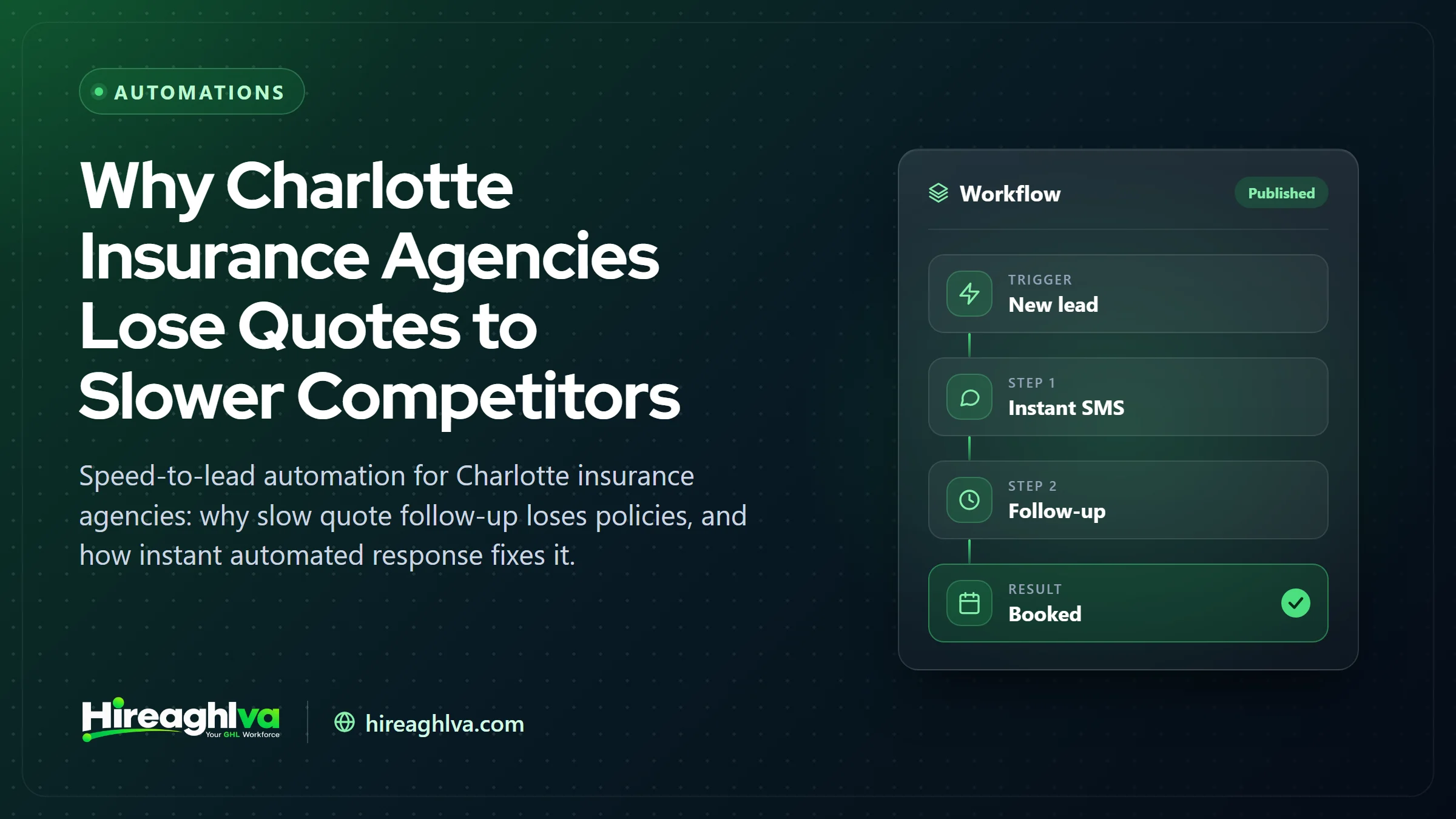
A quote-request workflow, stage by stage
| Stage | What happens | When it should happen |
|---|---|---|
| 1. Instant acknowledgment | Text or email confirms the request was received | Within seconds of the request |
| 2. Coverage-type routing | Auto, home, life, and business quotes routed separately | Immediately, based on what was requested |
| 3. Agent task with deadline | A specific agent is assigned with a hard response window | Within minutes |
| 4. Follow-up if no response | Escalates automatically if the deadline passes | Same day |
How the workflow actually runs, coverage line by coverage line
The four stages above look the same on a diagram for every coverage type, but what actually has to happen inside each stage is genuinely different depending on what someone is requesting a quote for. Treating every line of business the same way is one of the most common reasons a “speed-to-lead automation” ends up being a single generic autoresponder instead of something that actually fits how an agency sells.
Auto insurance
Auto is the highest-volume, fastest-decision line, and the one where shoppers most expect instant-quote-tool speed carried through to the human follow-up. The acknowledgment should confirm the vehicle and driver details received, set the expectation of a callback the same day, and — where the agency’s process allows it — offer a same-day appointment slot directly in the text. Routing is usually the simplest of the four: whichever agent or team handles personal auto, assigned by round robin or territory. The agent deadline should be the tightest of any line, often inside the hour, because auto shoppers churn through competing quotes the fastest and have the lowest switching cost of any coverage type.
Home insurance
Home quotes carry more urgency variance than auto: some are routine shopping, but a large share are tied to a mortgage closing date, which makes the deadline for a binder non-negotiable on the buyer’s side, not just a nice-to-have. The intake step should capture whether the request is closing-related and, if so, the closing date — that single field changes the whole follow-up plan. A closing-driven request should route immediately to whichever agent handles binders and escalate far faster than a routine renewal-shopping request, because missing a closing deadline doesn’t just lose a policy, it can jeopardize the buyer’s closing itself and burns the relationship with whichever mortgage broker or real estate agent referred the lead.
Life insurance
Life is the outlier of the four: it’s rarely a same-day decision, and the first conversation is usually a needs discussion, not a quote. Instant acknowledgment still matters — it’s what gets the shopper to actually show up for a scheduled call instead of forgetting they inquired — but the “quote” stage of the workflow should really be “book a needs-analysis conversation,” with the agent deadline measured in getting a call scheduled within a day or two rather than a number back within the hour. Trying to force a same-hour quote turnaround on life insurance usually produces a rushed, lower-quality conversation instead of a faster sale.
Business and commercial insurance
Commercial quotes are the most likely to need a specialist rather than whichever agent is next in the queue — a business owners’ policy, a contractor’s liability policy, and a professional liability policy for a medical practice are different enough that routing by industry or policy type matters more here than anywhere else. The acknowledgment should confirm the business type and coverage need, routing should check for an existing specialist on staff before falling back to a generalist, and the agent deadline is usually same-day rather than same-hour, because gathering the information needed for a real commercial quote (payroll, revenue, prior claims history) takes a scheduling conversation first, not an instant number.
Coverage-specific routing matters. An auto quote and a business policy quote need different follow-up messaging, and often a different agent entirely — a single blended response treats every shopper the same way and loses that distinction.
Credibility needs to show up fast, too. A shopper comparing several agencies decides partly on trust signals — carriers represented, years in business, real reviews — which is why the website behind the quote form matters as much as the automation behind it.
Common mistakes agencies make trying to fix this themselves
Most agencies that lose quotable business to speed aren’t doing nothing — they’ve usually already tried something. These are the mistakes that keep that something from actually working.
- Treating every coverage type as one pipeline. A single catch-all “new lead” workflow sends the same message and routes to the same person regardless of whether someone wants an auto quote or a commercial policy, which means the message is generic enough to feel like spam and the routing is wrong often enough to add delay instead of removing it.
- Sending one acknowledgment and calling it done. An instant text that confirms receipt is the start of the workflow, not the whole thing. Without an agent task, a deadline, and an escalation step behind it, “we got your request!” is a dead end the moment the shopper replies or the agent gets busy with something else.
- No escalation path when the assigned agent doesn’t respond. Every agent has a day where they’re slammed, out sick, or simply miss a notification. Without an automatic escalation to a backup or manager when the response deadline passes, the lead sits exactly where a slow manual process would have left it — the automation just delayed the failure instead of preventing it.
- Building it once and never testing it again. Pipelines get renamed, form fields change, a new lead source gets added — and a workflow built a year ago quietly stops firing for one of those sources without anyone noticing until someone asks why a lead went cold. A workflow that isn’t re-tested periodically degrades silently.
- Firing too many messages too fast. Overcorrecting for slowness by sending three texts and two emails in the first twenty minutes reads as desperate or pushy rather than responsive, and gives a shopper who was on the fence a reason to opt out of the whole sequence.
- Ignoring after-hours and weekend leads. A workflow that only runs during business hours leaves every evening and weekend quote request sitting exactly as unmanaged as it was before any automation existed — and a meaningful share of online quote shopping happens outside standard office hours in the first place.
- No reporting on actual response time. Without tracking median time-to-first-contact and the share of leads reached within the target window, an agency has no way to know whether the automation is actually working or has quietly broken, and no way to spot that leads from one particular source or time of day are consistently slipping through.
- Skipping compliance and opt-out handling to move faster. Speed is never a reason to cut corners on how automated texts and emails are built. SMS messaging still has to honor opt-out requests immediately and avoid implying coverage is bound before an agent has actually confirmed it — an automation that’s fast but non-compliant trades one problem for a much more expensive one.
Before and after: what actually changes
Quote request gets an instant acknowledgment
- With speed-to-lead automation
- Without it
Routed to the right agent by coverage type
- With speed-to-lead automation
- Without it
Agent has a hard response deadline
- With speed-to-lead automation
- Without it
Escalates automatically if nobody responds
- With speed-to-lead automation
- Without it
Depends on someone checking the inbox eventually
- With speed-to-lead automation
- Without it
| With speed-to-lead automation | Without it | |
|---|---|---|
| Quote request gets an instant acknowledgment | ||
| Routed to the right agent by coverage type | ||
| Agent has a hard response deadline | ||
| Escalates automatically if nobody responds | ||
| Depends on someone checking the inbox eventually |
What this actually costs, and what it’s worth
How the common approaches to lead follow-up compare
| Approach | Setup effort | Ongoing cost structure | Risk of leads slipping through |
|---|---|---|---|
| No automation — manual inbox checking | None | No direct cost, but ties up staff time ad hoc | High — depends entirely on who happens to check, and when |
| Generic autoresponder plug-in | Low — a few hours | Flat monthly SaaS fee | Medium — acknowledges instantly but does not route, assign, or escalate |
| Built speed-to-lead workflow (coverage-routed) | 1–2 weeks, one-time build | Fixed build cost plus a GoHighLevel subscription | Low — a missed deadline escalates automatically instead of going quiet |
| Dedicated inbound call center / BDC staff | Ongoing hiring and management | Salary and overhead per rep, every month | Low, but expensive to justify at a single-location agency’s lead volume |
The honest way to think about return on investment here isn’t “how many extra policies does this generate” — it’s “how many policies does the agency already generate, that are currently going to a faster competitor instead.” The marketing spend, SEO, referral relationships, or ad budget that produced the quote request has already been paid for by the time the lead hits the inbox; a slow response doesn’t just lose the sale, it wastes everything spent getting that shopper to request a quote in the first place. A build that’s a fixed one-time cost plus a modest monthly subscription tends to pay for itself quickly against that backdrop, because recovering even a small number of quotes a month that would otherwise have gone to whoever called first is recovering business the agency already paid to generate — not new spend chasing new leads.
It’s also worth comparing this to the alternative of simply hiring to solve the same problem: a part-time or full-time person whose job is to watch the inbox and respond fast runs a recurring salary cost indefinitely, scales awkwardly (a second location or a busy season means another hire), and still depends on that person being at their desk. A workflow doesn’t call in sick, doesn’t need a schedule, and scales to lead volume at no additional cost once it’s built.
There’s a second, less obvious piece of the ROI math that’s specific to insurance: the value of a single retained or won policy compounds over years of renewal premium and referral potential, not just the first transaction. A homeowner or business owner who’s happy with how quickly and clearly they were handled at the quote stage tends to renew, add other policies with the same agency over time, and refer friends and family doing the same search — while one who had to wait two days for a callback has no reason to give the agency a second look at the next renewal, let alone recommend it to anyone else. A speed-to-lead workflow is really protecting that entire multi-year relationship, not just the single quote that triggered it.
How to tell a real speed-to-lead system from a basic autoresponder
Plenty of things get sold as “speed-to-lead” that are really just an autoresponder with a better name. Before paying for one — whether from us or anyone else — these are the questions that separate a real system from a single automated text:
- “What happens after the first message sends?” If the honest answer stops at “it sends a text,” that’s an autoresponder, not a workflow. A real system creates a task for a specific agent, with a visible deadline, and something that happens automatically if that deadline is missed.
- “How does it treat an auto quote differently from a commercial quote?” If every lead gets the same message and routes to the same inbox regardless of coverage type, the “system” isn’t actually using the information the shopper already gave it.
- “What happens if the assigned agent doesn’t respond in time?” This is the escalation step, and it’s the single biggest differentiator between a system that actually catches mistakes and one that just delays them. There should be a concrete answer — a specific backup person or manager, and a specific time window — not a vague “it follows up again.”
- “Can I see response-time reporting, or do I just have to trust it’s working?” A real system can tell you median time-to-first-contact and what share of leads got reached inside the target window. If there’s no way to measure it, there’s no way to know it’s actually working six months from now.
- “Who owns the data and the workflow if we ever switch providers?” This matters more than it sounds like it should. Make sure the workflow lives in a platform your agency controls — like your own GoHighLevel account — rather than locked inside a vendor’s black-box tool you’d have to rebuild from scratch to leave.
- “What does testing and ongoing maintenance actually look like?” Pipelines get renamed, forms change, new lead sources get added — ask what happens when that breaks something, and whether re-testing is part of the deal or a separate bill every time.
- “How does the automation stay compliant on messaging?” Ask specifically how opt-outs are honored and how the wording avoids implying a quote is a bound policy. A vendor who can’t answer this concretely hasn’t thought about it, which is a bigger problem than a slow workflow.
A basic autoresponder isn’t worthless — an instant acknowledgment beats silence every time — but it’s solving a smaller slice of the problem than agencies usually think they’re buying. The acknowledgment is stage one of four. A system that stops there is still leaving the other three stages to chance.
What you actually get
- You stop losing quotes to whoever simply called back first. The moment a request comes in, it gets acknowledged and routed — no more waiting on someone to notice it.
- Agents spend time on quotes that are still live, not chasing shoppers who already bought from someone faster days ago.
- Nothing falls through the cracks during a busy week. The escalation step catches a lead an agent might otherwise forget about.
- You get a documented, repeatable process instead of response time depending on who happens to be at their desk — the same speed-to-lead structure that applies across any lead-driven business.
If you’d rather have a dedicated specialist run this day to day, see our GoHighLevel VA plans for ongoing management options.
Bringing it together
An insurance agency doesn’t need a better rate to win more policies — it needs to stop losing quotable business to competitors who simply called back faster. That’s doubly true in a market like Charlotte, where population growth keeps producing first-time shoppers with no existing agency loyalty, and where a dense field of independent agencies, captive agents, and online insurers means every one of those shoppers already has several other quotes landing in their inbox at the same time as yours. Speed-to-lead automation closes that gap without adding headcount, by routing each coverage type correctly, giving agents a real deadline, and escalating automatically when something gets missed — rather than leaving response time dependent on whoever happens to check the inbox next. Pair it with a fast, credible insurance agency website and sharp funnel graphics that build trust the moment someone lands on your quote form, and the whole intake process — from click to quote to policy — moves at the speed shoppers already expect.
Written by the Hireaghlva GoHighLevel team
We build and run GoHighLevel accounts, automations, dashboards, and websites for agencies and local businesses across the US and Canada. This guide reflects that hands-on work, with sources cited inline where we reference outside data.