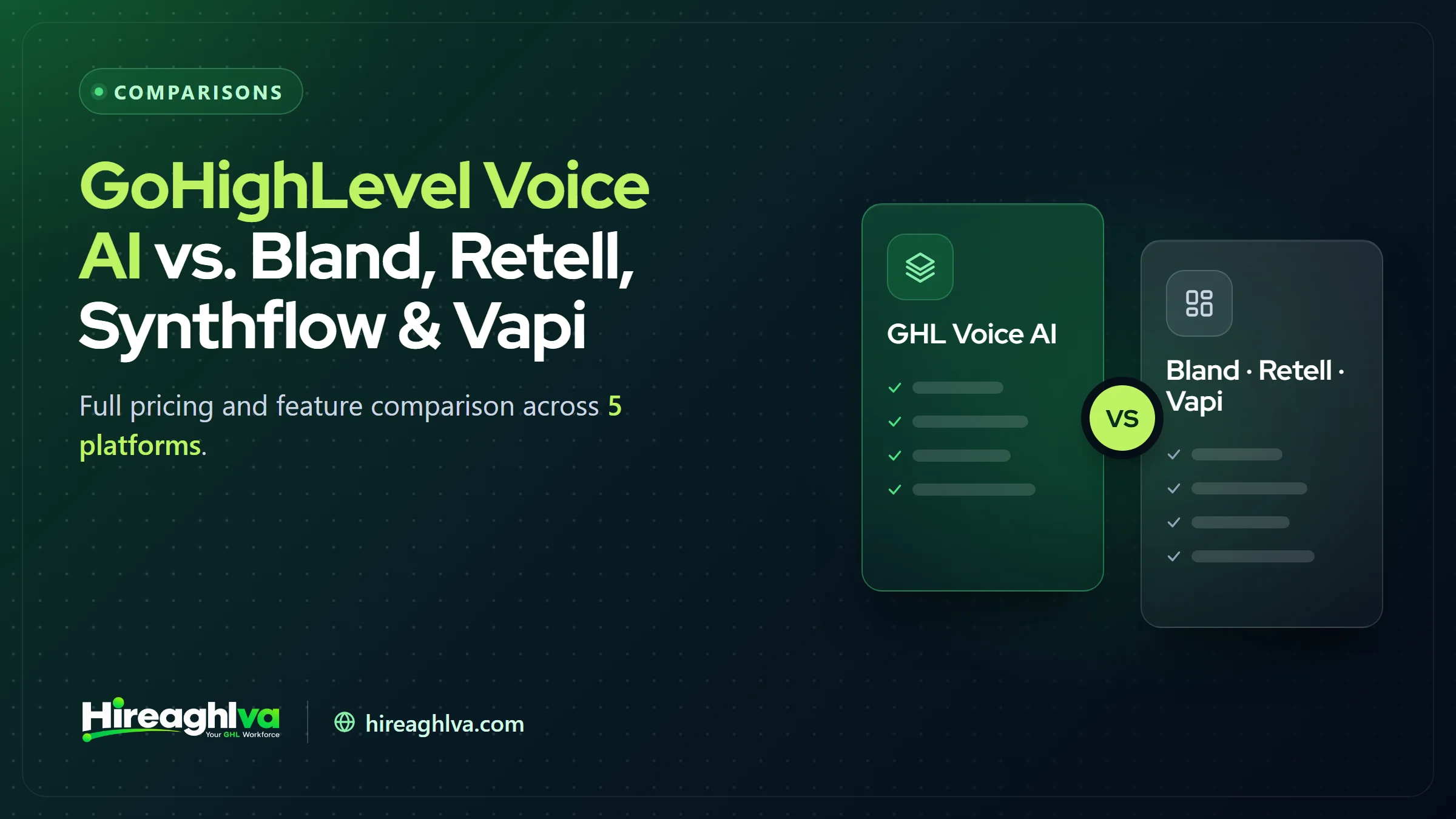
If you’re already running GoHighLevel, its native Voice AI is usually the best choice, because calls update the same CRM contacts and workflows your team already uses; Bland AI, Retell AI, Synthflow, and Vapi each win narrower use cases. It’s still worth knowing how it actually stacks up against the dedicated voice AI platforms agencies and developers frequently build on instead. This is a full pricing and feature comparison across five real options.
The AI voice agent space has grown crowded enough in 2026 that headline per-minute rates alone are close to meaningless for comparison purposes — every platform in this guide advertises a competitive-sounding number that excludes some real cost component, whether that’s telephony, speech-to-text, or LLM processing. This guide normalizes the comparison to actual, realistic all-in costs, not marketing headlines.
$0.07–$0.23/min
Per-minute range in this guide, from Retell's $0.07 base to GoHighLevel premium TTS (~$0.23)
Telephony billing
The single biggest source of "real" cost differences between platforms
Native CRM
GoHighLevel's clearest structural advantage over the standalone tools
The five platforms at a glance
GoHighLevel Voice AI
- Pricing basis
- Unbundled: engine + TTS + LLM + phone
- Telephony included?
- Yes, billed as part of the same account
Bland AI
- Pricing basis
- Flat $0.09/min
- Telephony included?
- Yes, bundled in flat rate
Retell AI
- Pricing basis
- $0.07/min base, pay-as-you-go
- Telephony included?
- Available, but telephony and LLM costs can be billed on top of the base rate
Synthflow
- Pricing basis
- ~$3,375/mo (Pro, ~5,000 calls)
- Telephony included?
- Yes, bundled
Vapi
- Pricing basis
- Variable, ~$2,250–$4,950/mo at scale
- Telephony included?
- No — bring your own Twilio/Telnyx
| Pricing basis | Telephony included? | |
|---|---|---|
| GoHighLevel Voice AI | Unbundled: engine + TTS + LLM + phone | Yes, billed as part of the same account |
| Bland AI | Flat $0.09/min | Yes, bundled in flat rate |
| Retell AI | $0.07/min base, pay-as-you-go | Available, but telephony and LLM costs can be billed on top of the base rate |
| Synthflow | ~$3,375/mo (Pro, ~5,000 calls) | Yes, bundled |
| Vapi | Variable, ~$2,250–$4,950/mo at scale | No — bring your own Twilio/Telnyx |
A low headline rate that excludes telephony, speech-to-text, and LLM cost can end up costing meaningfully more once those components are added back in — most platforms’ advertised per-minute rate doesn’t cover the full bill. Always compare full, all-in cost per minute — not the marketing headline rate — across any of these platforms (Zeeg, AI Voice Agents Pricing Guide: 11 Tools Compared).
GoHighLevel Voice AI
Since the May 2026 unbundling into separate voice engine, text-to-speech, LLM token, and phone charges, GoHighLevel’s Voice AI cost is genuinely competitive at the budget-TTS end ($0.072–$0.077/min including phone charges, before LLM tokens) and less so at the premium-TTS end ($0.227–$0.232/min, before LLM tokens). Its clearest advantage isn’t raw price — it’s native integration with GoHighLevel’s CRM, workflows, and contact records, meaning a Voice AI-handled call immediately updates the same contact history your team already works from, with no separate integration step required. That same contact record can then trigger the rest of your GoHighLevel automations and workflows, such as a follow-up text or a pipeline stage change.
Bland AI
Flat $0.09/minute, telephony included. Bland is commonly recommended specifically for high-volume outbound calling campaigns — its infrastructure and pricing are oriented toward that use case, making it a strong fit for businesses running large-scale outbound campaigns rather than primarily inbound support/booking.
Retell AI
$0.07/minute base pay-as-you-go, with telephony and LLM costs that can be billed on top of that base rate. Retell is generally regarded as the latency leader, with sub-700ms response times commonly cited — a genuine advantage for use cases where conversational responsiveness matters most, like live appointment booking where a caller will notice any lag. If fast response is your main goal, our speed-to-lead automation guide covers the workflow side of reaching a new lead first.
Synthflow
Priced more like an enterprise SaaS product than a metered API — roughly $3,375/month for a Pro tier covering approximately 5,000 monthly calls at a 3-minute average. Synthflow is generally positioned as the best fit for non-technical teams who want to configure a voice agent without developer involvement, trading some of the granular control other platforms offer for a more guided setup experience.
Vapi
The most developer-oriented option — variable pricing (roughly $2,250–$4,950/month at meaningful scale) and requires bringing your own Twilio or Telnyx account for telephony, billed entirely separately from Vapi’s own AI processing fees. This gives maximum flexibility for custom, complex integrations, at the cost of meaningfully more setup complexity than the more bundled alternatives.
Feature comparison beyond price
GoHighLevel Voice AI
- Best for
- Native CRM integration, existing GHL users
- Trade-off
- Less specialized than dedicated voice-only platforms
Bland AI
- Best for
- High-volume outbound campaigns
- Trade-off
- Less appointment-booking-focused tooling
Retell AI
- Best for
- Low-latency, appointment booking
- Trade-off
- Requires separate CRM integration
Synthflow
- Best for
- Non-technical setup, guided config
- Trade-off
- Higher cost at scale, less granular control
Vapi
- Best for
- Custom, complex integrations
- Trade-off
- Most setup complexity, separate telephony billing
| Best for | Trade-off | |
|---|---|---|
| GoHighLevel Voice AI | Native CRM integration, existing GHL users | Less specialized than dedicated voice-only platforms |
| Bland AI | High-volume outbound campaigns | Less appointment-booking-focused tooling |
| Retell AI | Low-latency, appointment booking | Requires separate CRM integration |
| Synthflow | Non-technical setup, guided config | Higher cost at scale, less granular control |
| Vapi | Custom, complex integrations | Most setup complexity, separate telephony billing |
Common mistakes when comparing voice AI platforms
Comparing headline per-minute rates without normalizing for included components. As covered above, a platform’s advertised rate that excludes telephony looks artificially cheap next to one (like GoHighLevel or Bland) that bundles it — always normalize to a true all-in cost before comparing.
Ignoring setup and integration time as a real cost. A platform with a lower per-minute rate but weeks of custom integration work (Vapi, for a team without existing developer capacity) can end up more expensive in total cost of ownership than a slightly pricier but much faster-to-deploy alternative, once staff time is properly accounted for.
Assuming the cheapest platform for a given volume is automatically the right choice. Cost is one factor among several — latency requirements, CRM integration needs, and team technical capacity all matter, and the cheapest option on a pure per-minute basis isn’t always the best overall fit once those other factors are weighed.
Not testing with your actual use case before committing to volume-based pricing. Synthflow’s and Vapi’s higher-volume pricing tiers assume a certain call pattern — testing with your actual expected call length and complexity before committing to a volume-tier contract avoids discovering a mismatch after you’re already locked into pricing based on an inaccurate volume estimate.
A note on staying current with this comparison
AI voice platform pricing and capabilities are moving targets — GoHighLevel’s own May 2026 unbundling is a clear example of how quickly the underlying economics can shift, and the same is true for the dedicated platforms covered here, which regularly adjust pricing and add capabilities. Treat the specific dollar figures in this guide as directionally accurate and useful for comparison purposes, but verify current pricing directly against each platform’s own pricing page before making a final decision, particularly if you’re reading this guide some months after its publication date.
Which voice AI platform should you choose?
Choose GoHighLevel Voice AI if GoHighLevel is already your CRM, Bland AI for high-volume outbound, Retell AI for the lowest latency, Synthflow for a non-technical team, and Vapi for a custom developer build.
Voice AI platform fit by situation
| Your situation | Best fit | Why |
|---|---|---|
| Already using GoHighLevel as your CRM | GoHighLevel Voice AI | Native CRM, workflow, and contact-record integration |
| High-volume outbound campaigns | Bland AI | Outbound-oriented infrastructure, flat $0.09/min with telephony |
| Latency-critical live booking | Retell AI | Sub-700ms response times commonly cited |
| Non-technical team, guided setup | Synthflow | Designed for setup without developer involvement |
| Custom, developer-driven integration | Vapi | Deepest customization, bring-your-own Twilio or Telnyx |
Already running GoHighLevel as your CRM? Use its native Voice AI — the integration advantage generally outweighs the modest cost gap versus dedicated platforms, unless you’re running genuinely high volume where premium-TTS costs compound significantly.
Running high-volume outbound campaigns, not tied to a specific CRM? Bland AI’s outbound-oriented infrastructure and flat rate are worth evaluating directly.
Need the lowest possible latency for live conversational booking? Retell AI’s latency performance is the most commonly cited differentiator in this category.
Non-technical team wanting a guided setup? Synthflow trades some cost efficiency for meaningfully less setup complexity.
Building a custom, developer-driven integration? Vapi’s flexibility and bring-your-own-telephony model fits custom build requirements dedicated platforms with more bundled pricing don’t accommodate as easily.
Contract terms and commitment structure
Beyond per-minute or per-month pricing, it’s worth understanding how each platform structures commitment. GoHighLevel’s Voice AI, whether pay-per-use or Unlimited AI, follows standard monthly SaaS billing with no long-term contract required — you can adjust or discontinue usage month to month. Bland AI and Retell AI similarly offer pay-as-you-go structures without requiring long-term commitments for their base pricing. Synthflow’s tier-based pricing (the ~$3,375/month Pro tier, for instance) more closely resembles a committed subscription plan, which may include minimum-term commitments depending on the specific contract — worth confirming directly before committing, since tier-based enterprise-style pricing sometimes carries different cancellation terms than pure pay-as-you-go models. Vapi’s variable, usage-driven pricing is generally structured without long-term commitment requirements, consistent with its developer-API-first positioning.
Which voice AI platform is cheapest at 5,000 calls a month?
At 5,000 three-minute calls a month, Retell AI’s base rate ($1,050) and GoHighLevel Voice AI on standard text-to-speech ($1,080–$1,155 before LLM tokens) are the lowest estimates, with Bland AI close behind at ~$1,350. Putting all five platforms on the same volume basis makes the comparison concrete rather than abstract:
GoHighLevel (standard TTS)
- Est. monthly cost
- ~$1,080-1,155
- Notes
- Engine + budget TTS + phone (~$0.072–$0.077/min × 15,000 min), excl. LLM tokens
GoHighLevel (premium TTS)
- Est. monthly cost
- ~$3,405-3,480
- Notes
- Engine + ElevenLabs V3 + phone (~$0.227–$0.232/min × 15,000 min), excl. LLM tokens
Bland AI
- Est. monthly cost
- ~$1,350
- Notes
- Flat $0.09/min × 15,000 min
Retell AI
- Est. monthly cost
- ~$1,050+
- Notes
- $0.07/min base, additional costs likely apply
Synthflow
- Est. monthly cost
- ~$3,375
- Notes
- Pro tier, roughly matches this exact volume
Vapi
- Est. monthly cost
- ~$2,250-4,950
- Notes
- Highly variable based on configuration + separate telephony
| Est. monthly cost | Notes | |
|---|---|---|
| GoHighLevel (standard TTS) | ~$1,080-1,155 | Engine + budget TTS + phone (~$0.072–$0.077/min × 15,000 min), excl. LLM tokens |
| GoHighLevel (premium TTS) | ~$3,405-3,480 | Engine + ElevenLabs V3 + phone (~$0.227–$0.232/min × 15,000 min), excl. LLM tokens |
| Bland AI | ~$1,350 | Flat $0.09/min × 15,000 min |
| Retell AI | ~$1,050+ | $0.07/min base, additional costs likely apply |
| Synthflow | ~$3,375 | Pro tier, roughly matches this exact volume |
| Vapi | ~$2,250-4,950 | Highly variable based on configuration + separate telephony |
| Item | Value |
|---|---|
| Retell AI (base rate only) | 1050/mo |
| GoHighLevel (standard TTS, excl. LLM) | 1080/mo |
| Bland AI | 1350/mo |
| Vapi (plus separate telephony) | 2250/mo |
| Synthflow (Pro tier) | 3375/mo |
| GoHighLevel (premium TTS, excl. LLM) | 3405/mo |
At this volume, GoHighLevel’s standard-TTS configuration and Retell AI’s base rate come out as the most cost-competitive options, while Synthflow and premium-TTS GoHighLevel land at the higher end — largely reflecting each platform’s positioning (Synthflow’s guided, non-technical setup carries a premium; GoHighLevel’s premium TTS is a deliberate quality choice, not a platform-wide cost characteristic).
White-label and reseller support
For agencies planning to resell voice AI capability to their own clients under their own brand, white-label support differs meaningfully across these platforms:
Strong
GoHighLevel (Agency Pro) — full white-label + rebilling, purpose-built for this
Varies
Bland/Retell/Synthflow/Vapi — API-level reselling possible but requires more custom build-out
GoHighLevel’s Agency Pro tier is the most turnkey option for reselling voice AI (and everything else) under an agency’s own brand, since white-labeling and client billing are core, designed-for features rather than something to build on top of an API. The dedicated voice AI platforms can generally be resold too, but doing so typically requires the agency to build its own client-facing billing and branding layer on top of the underlying API, which is real additional engineering work GoHighLevel’s Agency Pro tier removes entirely. For the client-facing side of that, see our guide to white-label client portals and reporting in GoHighLevel.
Integration ecosystem and CRM connectivity
GoHighLevel Voice AI connects natively to GoHighLevel’s own CRM, workflows, and contact records — no separate integration needed if GoHighLevel is already your operational hub. Retell AI, Synthflow, and Vapi generally connect to external CRMs (including GoHighLevel) via API or webhook integrations, which work well but require setup and maintenance as a distinct integration layer rather than native connectivity. Bland AI similarly connects via API, with particular strength in integrating with outbound-calling-oriented sales tools and dialers rather than general CRM platforms specifically.
If your CRM is already GoHighLevel, this integration question resolves itself clearly in GoHighLevel Voice AI’s favor. If you’re not using GoHighLevel (or any specific CRM) as your core system, the integration question becomes genuinely open, and the dedicated platforms’ API-first design may actually offer more flexibility for connecting to whatever specific stack you’re already running. If you’re still choosing that core CRM, our GoHighLevel vs. HubSpot pricing and features comparison is a useful starting point.
Voice quality and customization depth
All five platforms support a range of voice options, but customization depth varies. GoHighLevel’s TTS provider choice spans from budget (OpenAI/Cartesia) to premium (ElevenLabs) options. Retell AI and Synthflow both similarly offer multiple voice provider options with cost tiers. Vapi, being the most developer-oriented, generally offers the deepest customization for teams wanting to fine-tune voice characteristics, interruption handling, and conversation flow at a granular level — appropriate for teams with the technical capacity to use that flexibility, less useful for teams wanting a simpler, more guided setup.
How long does it take to set up each voice AI platform?
Setup typically takes hours to 1–2 days for GoHighLevel Voice AI (for existing GHL users), hours to 1 day for Synthflow, 1–3 days for Bland AI and Retell AI, and days to weeks for Vapi.
GoHighLevel Voice AI
- Typical setup time
- Hours to 1-2 days
- Technical skill required
- Low — configured within familiar GHL interface
Bland AI
- Typical setup time
- 1-3 days
- Technical skill required
- Low-moderate — API or no-code builder
Retell AI
- Typical setup time
- 1-3 days
- Technical skill required
- Moderate — some technical configuration
Synthflow
- Typical setup time
- Hours to 1 day
- Technical skill required
- Low — designed for non-technical setup
Vapi
- Typical setup time
- Days to weeks
- Technical skill required
- High — developer-oriented, custom build
| Typical setup time | Technical skill required | |
|---|---|---|
| GoHighLevel Voice AI | Hours to 1-2 days | Low — configured within familiar GHL interface |
| Bland AI | 1-3 days | Low-moderate — API or no-code builder |
| Retell AI | 1-3 days | Moderate — some technical configuration |
| Synthflow | Hours to 1 day | Low — designed for non-technical setup |
| Vapi | Days to weeks | High — developer-oriented, custom build |
For a business wanting to move fast without dedicated developer resources, GoHighLevel (if already a GHL user) and Synthflow both offer the fastest, most accessible paths to a working voice agent. Vapi’s setup investment pays off specifically for teams building something genuinely custom that the more guided platforms don’t accommodate. If you’re a GoHighLevel user without in-house capacity, a GoHighLevel VA can handle configuration, while builds that go beyond native features fall under custom GoHighLevel software.
Frequently asked comparison questions
“Can I switch between these platforms later if my choice doesn’t work out?” Generally yes, though migration effort varies — conversation flows, prompts, and integration logic built on one platform typically need to be rebuilt (not directly transferred) on another, since each platform has its own configuration approach and API structure.
“Do any of these platforms offer a free trial to test before committing?” Trial availability and terms change over time across all five platforms — checking current offers directly on each platform’s pricing page at the time of evaluation is more reliable than relying on a fixed claim from any comparison guide, including this one.
“Which platform is best for multi-language support?” This varies by platform and changes as each one’s language model and TTS provider support evolves — if multi-language support is a hard requirement, verify current language coverage directly against your specific needed languages for each platform under consideration, rather than assuming broad coverage across the board.
Bringing it together
For a business already running GoHighLevel, its native Voice AI is the right default in the overwhelming majority of cases — the CRM integration advantage is hard to replicate by bolting on a separate platform, and the cost gap (particularly at standard-TTS configuration) is modest. The dedicated platforms earn their place for specific, narrower use cases: Bland for outbound-heavy campaigns, Retell for latency-critical booking, Synthflow for non-technical teams, and Vapi for fully custom developer builds outside any specific CRM ecosystem.
Run your own numbers using the volume-based comparison table above against your actual expected call volume before committing to any of these five — the crossover points between platforms shift meaningfully depending on your specific volume, TTS quality needs, and whether native CRM integration or maximum customization matters more for your use case.
For most GoHighLevel users, the practical starting point is simple: try the native Voice AI first, since it requires no new vendor relationship or integration work, and only evaluate the dedicated alternatives if a specific gap emerges — latency that’s genuinely too slow for your use case, outbound campaign volume that outgrows GoHighLevel’s tooling, or a custom integration need none of the more bundled platforms accommodate.
Written by the Hireaghlva GoHighLevel team
We build and run GoHighLevel accounts, automations, dashboards, and websites for agencies and local businesses across the US and Canada. This guide reflects that hands-on work, with sources cited inline where we reference outside data. Last reviewed September 13, 2026.