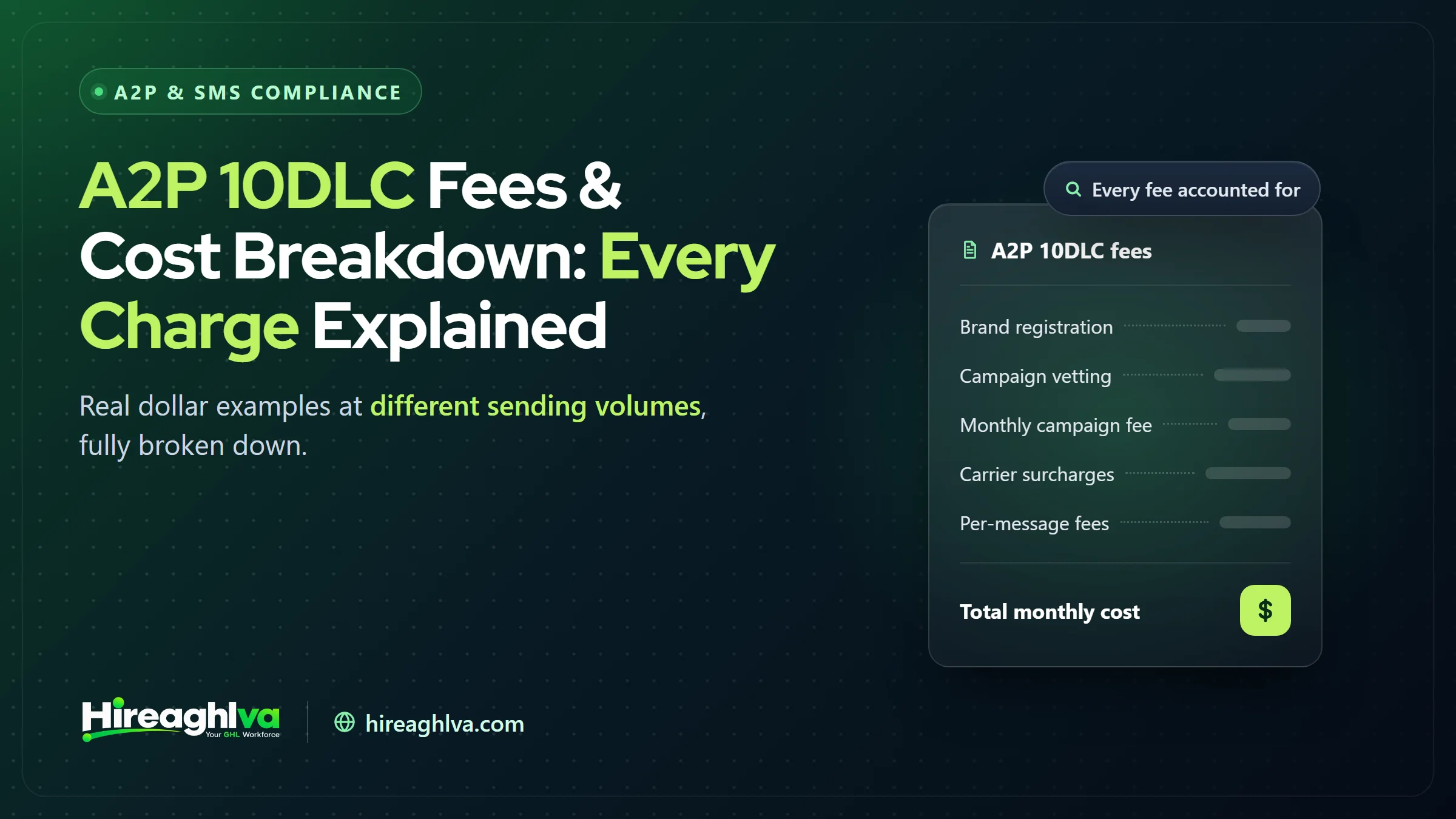
A2P 10DLC fees come in four parts: a one-time brand registration fee ($4.50 or $46), a one-time $15 campaign vetting fee, a small recurring monthly campaign fee, and per-message carrier surcharges. The individual A2P 10DLC fees are small enough that most guides mention them in a single sentence and move on — but they stack, some are recurring, and carrier surcharges scale directly with volume. This is the complete breakdown, with real dollar figures at different sending volumes, so there are no surprises on your first invoice.
None of these fees are set or marked up by GoHighLevel itself — they flow through from Twilio’s underlying infrastructure and the carriers’ own pass-through surcharges, which means the numbers in this guide apply whether you’re registering through GoHighLevel’s Trust Center or directly in Twilio’s console. What differs by platform is how (or whether) the costs get itemized on your bill, not the underlying amounts themselves.
$4.50
Sole Proprietor / Low-Volume Standard brand fee (one-time)
$46
Standard Brand fee, includes secondary vetting (one-time)
$15
Campaign use-case vetting fee (one-time, per campaign)
$0.003–$0.005
Per-message carrier surcharge (ongoing, per message)
The four fee categories
Every dollar you’ll spend on A2P 10DLC falls into one of four categories, and understanding which is one-time versus recurring versus volume-based is the key to actually budgeting for this accurately.
Brand registration fee
- Type
- One-time
- When charged
- At brand submission
Campaign vetting fee
- Type
- One-time per campaign
- When charged
- At first vetting decision
Monthly campaign fee
- Type
- Recurring
- When charged
- Every month the campaign is active
Carrier surcharge
- Type
- Per-message
- When charged
- Every message sent, ongoing
| Type | When charged | |
|---|---|---|
| Brand registration fee | One-time | At brand submission |
| Campaign vetting fee | One-time per campaign | At first vetting decision |
| Monthly campaign fee | Recurring | Every month the campaign is active |
| Carrier surcharge | Per-message | Every message sent, ongoing |
How much does A2P 10DLC brand registration cost?
A2P 10DLC brand registration costs a one-time $4.50 for Sole Proprietor or Low-Volume Standard brands and a one-time $46 for Standard brands, which includes secondary vetting.
One-time fee
- Sole Proprietor / Low-Volume Standard
- $4.50
- Standard Brand
- $46
Includes secondary vetting
- Sole Proprietor / Low-Volume Standard
- Standard Brand
Requires EIN
- Sole Proprietor / Low-Volume Standard
- Standard Brand
| Sole Proprietor / Low-Volume Standard | Standard Brand | |
|---|---|---|
| One-time fee | $4.50 | $46 |
| Includes secondary vetting | ||
| Requires EIN |
The Standard brand fee is higher specifically because it bundles secondary vetting — a more detailed carrier-side review that also raises your default trust score and throughput ceiling. This isn’t purely a “pay more for the same thing” situation; the extra ~$41.50 buys a meaningfully different starting position for higher-volume senders (Twilio Support, A2P 10DLC pricing and fees). If you don’t have an EIN yet, our guide to A2P Sole Proprietor registration without an EIN covers the $4.50 path in full.
How much are A2P 10DLC campaign fees?
A2P 10DLC campaigns cost a one-time $15 vetting fee plus a recurring monthly campaign fee, typically $2–$4/month for standard use cases and higher for marketing-focused campaigns.
Every campaign, regardless of brand type, carries a one-time $15 vetting fee charged at the campaign’s first review decision — approved or rejected, this fee applies once and isn’t charged again on resubmission of the same campaign after a rejection.
A2P 10DLC campaign fees by type
| Campaign fee | Amount | When charged |
|---|---|---|
| Campaign vetting fee | $15 | One-time, at the first review decision |
| Monthly fee: standard use cases (reminders, notifications, customer care) | ~$2–$4/month | Every month the campaign is active |
| Monthly fee: marketing-focused campaigns | Higher than standard use cases | Every month the campaign is active |
Standard use cases — appointment reminders, account notifications, general customer care — typically fall in the $2–$4/month range. Marketing-focused campaigns are priced higher, reflecting the additional carrier scrutiny and higher spam-risk profile associated with promotional content (GHL Scale Up, A2P 10DLC Fees Explained; HighLevel Support, A2P 10DLC Messaging Fees).
Carrier surcharges: the ongoing cost that scales with you
This is the fee category most businesses underestimate, because it’s billed per message rather than as a flat, predictable line item. AT&T, T-Mobile, and Verizon each apply their own per-message pass-through surcharge, typically in the $0.003–$0.005 range per message.
T-Mobile raised its per-message pass-through surcharge again in January 2026. These rates are set independently by each carrier and have generally trended upward over time — budget with some margin above current published rates rather than assuming today’s number holds indefinitely.
Real dollar examples at different volumes
~$3.50–$6.50/mo
A2P fees at 500 messages/month ($1.50–$2.50 surcharges + $2–$4 campaign fee)
~$8–$14/mo
A2P fees at 2,000 messages/month ($6–$10 surcharges + $2–$4 campaign fee)
~$32–$54/mo
A2P fees at 10,000 messages/month ($30–$50 surcharges + $2–$4 campaign fee)
These figures use this guide’s own rates — $0.003–$0.005 per message in carrier surcharges plus a $2–$4 monthly campaign fee — and exclude number rental and your platform’s base per-message send rate, covered below.
For a typical small sender, the real monthly bill runs roughly 1.5 to 2 times the headline per-message rate once carrier surcharges, number rental, and the monthly campaign fee are all added together — a business sending 10,000 messages a month should budget approximately $30–$50/month in carrier surcharges alone, on top of the campaign fee and any underlying per-message platform rate (textbee.dev, Twilio SMS Pricing 2026).
What’s NOT included in these fees
A few costs are easy to conflate with A2P 10DLC fees specifically but are actually separate line items:
Phone number rental. The monthly cost of the number itself (typically $1–$2/month for a local number) is billed separately from A2P registration — you’d pay this whether or not the number is A2P registered.
The underlying per-message send rate. Carrier surcharges are added on top of your platform’s base per-message SMS rate, not a replacement for it — GoHighLevel/Twilio’s standard SMS sending cost still applies per message beyond the A2P-specific surcharge.
GoHighLevel subscription fees. Your $97/$297/$497 monthly GoHighLevel plan fee is entirely separate from A2P 10DLC costs — A2P fees apply regardless of which GHL tier you’re on.
Worked rebilling example for agencies
Since SaaS Pro/Agency Pro-tier GoHighLevel agencies can rebill usage costs to clients with a markup, it’s worth seeing how A2P fees actually flow through a realistic client relationship. Take an agency onboarding a new home services client with expected volume around 2,000 messages/month:
Brand + campaign setup (one-time)
- Agency cost
- ~$61
- Typical client-facing price
- Often bundled into onboarding fee, not itemized
Monthly campaign fee
- Agency cost
- ~$3/mo
- Typical client-facing price
- Often absorbed into a flat monthly retainer
Carrier surcharges (2,000 msgs)
- Agency cost
- ~$6–$10/mo
- Typical client-facing price
- Passed through with an agency-set markup
| Agency cost | Typical client-facing price | |
|---|---|---|
| Brand + campaign setup (one-time) | ~$61 | Often bundled into onboarding fee, not itemized |
| Monthly campaign fee | ~$3/mo | Often absorbed into a flat monthly retainer |
| Carrier surcharges (2,000 msgs) | ~$6–$10/mo | Passed through with an agency-set markup |
Most agencies we’ve seen don’t itemize A2P registration fees as a separate client-facing line at all — the amounts are small enough relative to a typical monthly retainer that bundling them into onboarding or a flat “communications” line item is simpler for both sides than a granular pass-through. The carrier surcharge (the genuinely volume-scaling cost) is the piece worth a deliberate markup decision, since it compounds meaningfully at higher client volumes in a way the largely-fixed registration fees don’t.
Toll-free verification: the free alternative
Worth noting explicitly: toll-free verification currently carries no registration fee at all, unlike A2P 10DLC’s brand and campaign charges — standard messaging rates and carrier surcharges still apply to actual sends, but there’s no equivalent of the $4.50–$46 brand fee or $15 campaign vetting fee. Our toll-free vs. A2P 10DLC comparison covers the full trade-off, since toll-free’s lower cost comes with its own throughput and number-format trade-offs.
How agencies should think about these costs when rebilling clients
If you’re an agency managing A2P 10DLC across multiple client sub-accounts, these fees are a useful baseline for setting your own rebilling structure. Since brand and campaign fees are one-time (or small recurring amounts), many agencies simply pass these through to clients as an onboarding line item rather than marking them up significantly — the real margin opportunity in a GoHighLevel rebilling structure tends to be in usage-based line items like Conversation AI and Voice AI, not A2P registration fees themselves, which are small enough that heavy markup on them can look disproportionate to a client comparing notes with a competitor.
Is paying for secondary vetting worth it?
The Standard brand’s included secondary vetting raises your default trust score and throughput ceiling, but it’s worth being deliberate about whether that’s actually valuable for your specific sending volume rather than assuming more vetting is automatically better. For a single-location service business sending a few hundred to a couple thousand messages a month, default Standard brand throughput (without any additional paid vetting beyond what’s already included) is almost always more than sufficient — the ceiling only becomes a real constraint at meaningfully higher volumes, typically tens of thousands of messages a month sent in concentrated bursts.
If you’re a multi-location business or an agency aggregating significant volume across client accounts, and you’ve genuinely hit throughput limits in practice (not just as a theoretical concern), additional secondary vetting is a reasonable, targeted spend at that point — but it’s not something we’d recommend paying extra for preemptively before you’ve confirmed you actually need the higher ceiling. Start with standard registration, monitor whether you’re hitting throughput limits in practice, and escalate only if the data says you need to.
Comparing A2P 10DLC costs to the cost of not registering
It’s worth stating the counterfactual plainly, since it reframes these fees correctly: the alternative to paying A2P 10DLC fees isn’t “free SMS” — it’s SMS that carriers block outright. Since February 2025, an unregistered 10-digit number sending to US mobile numbers simply doesn’t deliver, full stop, regardless of message content or your own opt-in diligence. Framed against that reality, a realistic $200–$300 first-year cost for a typical service business isn’t really a discretionary expense to minimize — it’s closer to a fixed cost of having working SMS at all, in the same category as paying for the phone number itself.
How much does A2P 10DLC cost in the first year?
A single-location service business on a Standard brand sending about 3,000 messages a month realistically pays $200–$300 for A2P 10DLC in its first year, setup included.
Putting it together for a realistic single-location service business on a Standard brand, sending around 3,000 messages a month for appointment reminders and review requests:
~$61
One-time setup: $46 brand + $15 campaign vetting
~$36–$48/yr
Recurring monthly campaign fee at $3–$4/month
Add carrier surcharges (roughly $0.003–$0.005 × 3,000 messages × 12 months, or about $108–$180/year) and you land at a realistic first-year total in the $200–$300 range, inclusive of setup — a genuinely small line item relative to almost any service business’s marketing budget, but one worth knowing precisely rather than guessing at when setting client pricing or your own internal budget. Year two and beyond drop the one-time setup cost entirely, leaving just the recurring campaign fee and carrier surcharges — typically about $145–$230/year for this same volume profile going forward, assuming send volume and carrier rates stay roughly stable.
A2P 10DLC cost in the example scenario above (Standard brand, ~3,000 messages/month)
| Cost line | Year one | Year two and beyond |
|---|---|---|
| One-time setup ($46 brand + $15 campaign vetting) | ~$61 | $0 |
| Monthly campaign fee ($3–$4/month × 12) | ~$36–$48 | ~$36–$48 |
| Carrier surcharges ($0.003–$0.005 × 3,000 msgs × 12) | ~$108–$180 | ~$108–$180 |
| Realistic total | ~$205–$289 (roughly $200–$300) | ~$144–$228 (roughly $145–$230) |
| Item | Value |
|---|---|
| One-time setup ($46 brand + $15 vetting) | 61 |
| Monthly campaign fee ($4 × 12) | 48 |
| Carrier surcharges ($0.005 × 3,000 × 12) | 180 |
Hidden costs that catch people off guard
Beyond the four core fee categories, a few less obvious costs are worth planning for explicitly rather than discovering on an invoice:
Re-vetting or upgrade costs. If you start as Sole Proprietor and later upgrade to Standard once you get an EIN, you’re effectively paying the Standard brand fee on top of what you already spent on Sole Proprietor registration — there’s no credit or discount for the earlier registration, since it’s a genuinely new brand submission.
Multiple sub-account registration for agencies. Each client sub-account needs its own full registration — an agency onboarding ten clients pays ten separate sets of brand and campaign fees, not one shared agency-level fee. Budgeting per-client, not per-agency, avoids underestimating total setup cost across a client base (and the registration labor itself is a common task to hand to a GoHighLevel VA).
Failed vetting resubmission delays translating to lost revenue, not direct fees. While resubmitting a rejected campaign doesn’t cost extra in registration fees (our A2P rejection reasons and fixes guide helps you avoid one), the delay itself has a real cost if SMS-dependent revenue (appointment confirmations reducing no-shows, review requests, nurture sequences) is blocked during that period — worth factoring into how much buffer you build into a launch timeline, even though it won’t show up as a line item anywhere.
MMS surcharges, if you send images. MMS (picture messaging) typically carries its own, separate per-message rate distinct from standard SMS surcharges, generally higher since MMS involves more carrier-side processing than plain text.
How to audit your own current A2P spending
If you’re already registered and want to understand what you’re actually paying today rather than working from these general figures, a few places to check inside your GoHighLevel account: your monthly invoice/billing summary typically itemizes messaging usage separately from your subscription plan fee; Trust Center shows your registered campaigns and their associated use case (useful for confirming you’re not paying a marketing-tier monthly fee for what’s actually a standard-use campaign); and your Conversations page’s send volume over a recent period, multiplied by the current carrier surcharge rate, gives you a rough sanity check against what your invoice actually shows.
A quick sanity-check worth running once: if your actual monthly SMS bill is meaningfully higher than the volume-based estimates in this guide would suggest, the most common explanation is a marketing-tier campaign fee applied to what’s functionally standard-use messaging, or a higher-than-expected send volume from a workflow firing more often than intended — both are worth checking directly rather than assuming the fee structure itself is the problem. A careful GoHighLevel workflow automation audit catches the second one quickly.
A simple annual budget planning template
For a business trying to budget A2P 10DLC costs for the coming year, a workable approach: estimate your average monthly message volume, multiply by $0.004 (a reasonable mid-point carrier surcharge estimate) to get monthly surcharge cost, add your monthly campaign fee ($2–$4 for standard use cases), multiply the combined monthly figure by 12, and add the one-time brand and campaign vetting fees ($19.50–$61 depending on brand type) as a first-year-only line item. This gives a realistic full-year estimate without needing to track carrier rate changes precisely in advance — round up slightly to build in margin for the periodic surcharge increases carriers have historically applied.
Frequently overlooked billing questions
“Is the monthly campaign fee charged even in months I send very few or zero messages?” Yes — the monthly campaign fee is tied to having an active, approved campaign, not to actual send volume in a given month. Carrier surcharges, by contrast, are strictly volume-based and scale to zero if you send nothing.
“If I deactivate a campaign, do I stop paying the monthly fee immediately?” Generally yes, from the point of deactivation forward, though the exact billing-cycle cutoff can depend on your platform’s specific billing timing — worth confirming directly if you’re deactivating mid-cycle and want precision on the exact final charge.
“Do fees differ for Canadian numbers versus US numbers?” The core fee structure is broadly similar, though Canadian carriers (Bell, Rogers, Telus, and others) set their own surcharge rates independently of the US carriers, so exact per-message costs can differ modestly between the two countries even under the same underlying registration framework.
Bringing it together
A2P 10DLC’s fee structure is simpler than it first appears once separated into its four real categories: a one-time brand fee, a one-time campaign vetting fee, a small recurring monthly campaign fee, and ongoing per-message carrier surcharges that scale with volume. None of these are negotiable or GoHighLevel-specific markups — they reflect the actual underlying Twilio/carrier costs — and for the overwhelming majority of single-location service businesses, the realistic all-in cost lands well under $300 for the first year, setup included.
Use the volume-based estimates and the budget template above to set expectations before you register, check your actual invoice against them once you’re live, and treat any meaningful discrepancy as a signal to audit your campaign tier and send volume rather than assuming the fee structure itself has changed. For the registration process these fees are attached to, our complete A2P 10DLC guide and step-by-step GoHighLevel walkthrough cover the mechanics end to end.
Written by the Hireaghlva GoHighLevel team
We build and run GoHighLevel accounts, automations, dashboards, and websites for agencies and local businesses across the US and Canada. This guide reflects that hands-on work, with sources cited inline where we reference outside data.