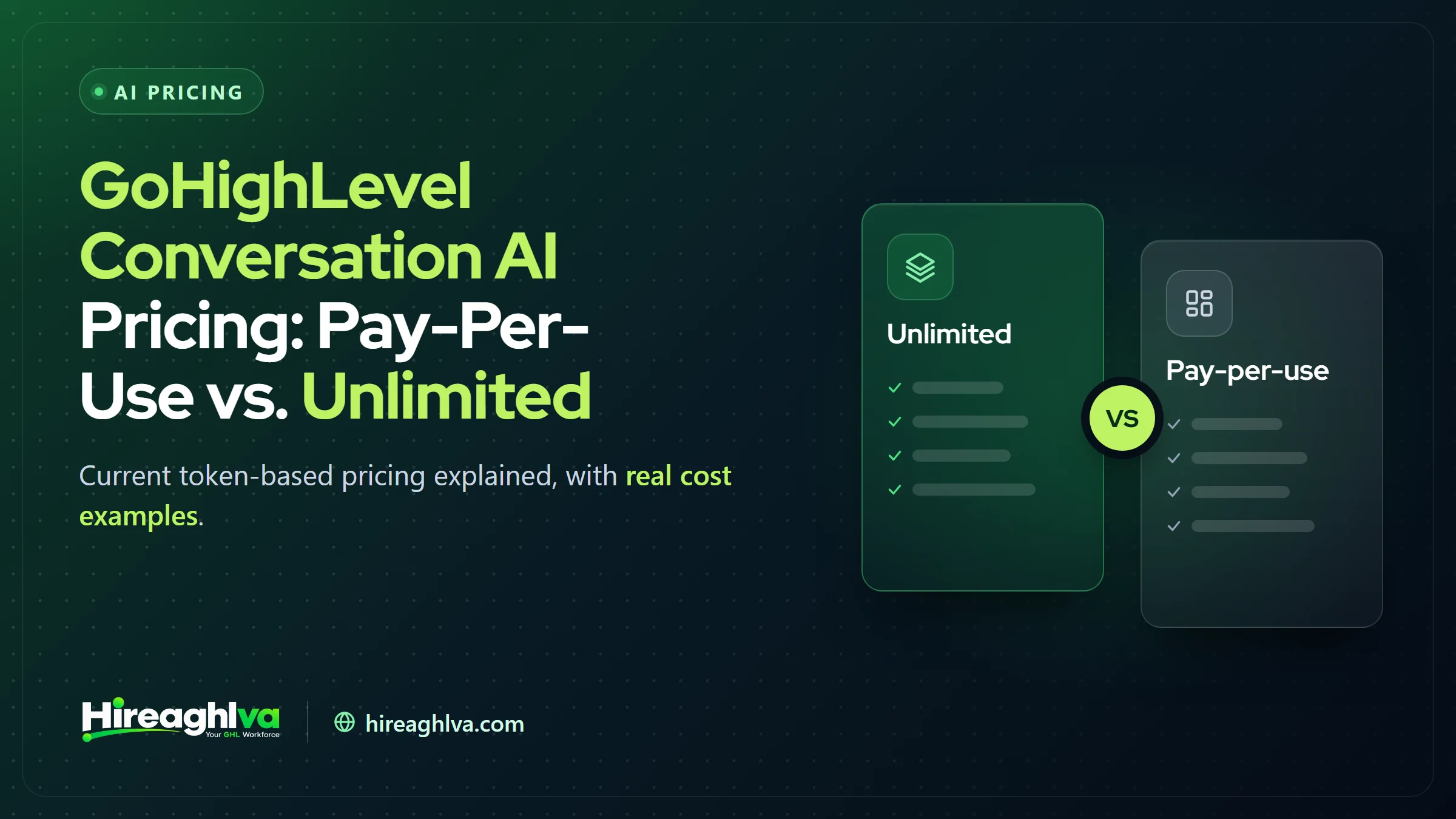
GoHighLevel Conversation AI is priced along a few tiers in 2026: token-based pay-per-use, which scales with how long and complex each conversation is; a lower-volume mid-tier AI add-on (marketed as AI Employee Growth, priced below the Unlimited plan) for accounts with modest AI usage; or the flat $97/month Unlimited AI plan per sub-account. Pricing has changed enough this year that a lot of comparison content and forum discussion now cites outdated numbers, so this is the current, accurate breakdown — with real examples to help you pick the right model for your actual usage. This guide focuses on the pay-per-use vs. Unlimited AI comparison, since that’s the choice that matters most once usage grows past a light, occasional level; check your account’s current AI add-on options for the exact terms of any mid-tier plan.
Conversation AI is GoHighLevel’s AI-driven chat handling layer — responding to inbound SMS, web chat, and other messaging channels automatically, qualifying leads, answering common questions, and booking appointments without requiring a human to be actively monitoring every channel in real time. Understanding what it actually costs, accurately, matters more than for most other GoHighLevel features specifically because the pricing model itself changed structurally in 2026, leaving a lot of outdated information still circulating.
Token-based
Current pay-per-use pricing model, replacing the old flat per-message rate
$97/mo
Unlimited AI plan — covers all 6 AI tools, per sub-account
6 tools
Voice, Conversation, Content, Reviews, Funnel, and Workflow AI, bundled under Unlimited
Pay-per-use vs. Unlimited AI
Pricing basis
- Pay-As-You-Go
- Token cost per conversation
- Unlimited AI Plan
- Flat $97/mo per sub-account
Scales with volume
- Pay-As-You-Go
- Unlimited AI Plan
Includes other AI tools
- Pay-As-You-Go
- Unlimited AI Plan
Best for
- Pay-As-You-Go
- Low/occasional AI usage
- Unlimited AI Plan
- High-volume or multi-tool AI usage
| Pay-As-You-Go | Unlimited AI Plan | |
|---|---|---|
| Pricing basis | Token cost per conversation | Flat $97/mo per sub-account |
| Scales with volume | ||
| Includes other AI tools | ||
| Best for | Low/occasional AI usage | High-volume or multi-tool AI usage |
GoHighLevel also offers a lower-cost mid-tier AI add-on (marketed as AI Employee Growth) between pay-per-use and the $97/month Unlimited plan, bundling a monthly allowance of AI usage for accounts with moderate volume. This guide compares the two ends of the spectrum in detail since that’s the decision most accounts eventually face — confirm current tier names, pricing, and included allowances in your account before committing.
What changed from the old pricing model
A commonly cited older figure — Conversation AI priced at a flat $0.02–$0.04 per message — no longer matches GoHighLevel’s current pricing table, which lists pay-per-use Conversation AI at token cost instead. If you’ve seen this older figure in a comparison article, a forum post, or an agency’s sales material, treat it as outdated rather than current (aigohighlevel.com, GoHighLevel AI Pricing 2026).
The shift to token-based pricing reflects how modern conversational AI actually incurs cost — a short, simple exchange consumes fewer tokens (and costs less) than a long, complex conversation involving multiple back-and-forth exchanges, which a flat per-message rate never accurately captured in the first place.
How does GoHighLevel’s token-based Conversation AI pricing work?
GoHighLevel charges pay-per-use Conversation AI by the tokens the underlying AI model consumes to read and answer each exchange, not a fixed cost per message. Rather than paying the same amount for every message sent, you’re charged based on the actual computational “tokens” consumed to process and generate each exchange in a conversation. A short, simple booking confirmation exchange consumes relatively few tokens; a longer conversation involving detailed questions, multiple exchanges, or complex reasoning consumes more. This means your actual cost per conversation varies naturally based on how complex your typical AI-handled interactions are, rather than every message costing the same flat amount regardless of content.
How conversation complexity affects token consumption on pay-per-use
| Conversation type | Example | Token consumption |
|---|---|---|
| Simple | Booking confirmation or a single FAQ answer | Fewest tokens — one short exchange |
| Moderate | Multi-turn qualifying questions | More — input and output tokens accumulate on every turn |
| Complex | Detailed troubleshooting or objection handling | Most — long messages, many turns, more reasoning |
What does GoHighLevel’s $97/month Unlimited AI plan include?
GoHighLevel’s Unlimited AI plan costs $97/month per sub-account and covers unlimited usage of all six AI tools — Conversation AI, Voice AI, Content AI, Reviews AI, Funnel AI, and Workflow AI — not just Conversation AI in isolation. This bundling matters for the value comparison: if you’re also using Voice AI, Content AI, or the other tools, the effective cost of unlimited Conversation AI usage within that bundle is lower than it would be if you were paying for Conversation AI’s flat fee alone.
Because the $97 is charged per sub-account, the flat-rate cost multiplies with every sub-account you activate it on:
| Item | Value |
|---|---|
| 1 sub-account | 97 |
| 3 sub-accounts | 291 |
| 5 sub-accounts | 485 |
| 10 sub-accounts | 970 |
Should you choose pay-per-use or Unlimited AI?
Choose pay-per-use when your Conversation AI volume is low or occasional, and the $97/month Unlimited AI plan when AI is a primary, high-volume channel or you also use Voice AI and the other AI tools.
Choose pay-per-use if: your AI-handled conversation volume is genuinely low or occasional (an after-hours coverage bot handling a handful of inquiries a night, for example), where the token-based cost stays comfortably below $97/month even with some buffer for growth.
Choose Unlimited AI if: Conversation AI is a primary engagement channel handling a meaningful share of your inbound inquiries, you’re also using other AI tools (Voice AI especially) where the bundled flat rate compounds in value, or your volume is growing quickly enough that predictable, capped costs are worth more to you than optimizing for the theoretical lowest per-conversation rate.
Low/occasional use
Pay-per-use likely cheaper — token cost stays well under $97/mo
High-volume / multi-tool use
Unlimited AI likely cheaper and more predictable
Industry-specific usage patterns worth knowing
Different business types tend to generate meaningfully different Conversation AI usage patterns, which affects which pricing model makes sense:
Home services businesses typically use Conversation AI for after-hours inquiry capture and basic scheduling questions — often alongside missed call text-back automation — moderate volume, generally short conversations, often a good fit for pay-per-use unless call volume is unusually high.
E-commerce and retail often route a higher volume of simple, repetitive questions (order status, return policy, product availability) through Conversation AI — high conversation count but typically low complexity per conversation, which can go either way depending on exact volume.
Real estate and property management frequently use longer, more qualifying-question-heavy conversations (budget, timeline, specific property interest) — higher token consumption per conversation, tilting the economics toward Unlimited AI sooner than a simpler-conversation business would hit that threshold.
Healthcare and dental practices tend toward a moderate, steady volume focused on appointment-related questions — generally predictable enough that either pricing model works reasonably well, with the choice coming down more to whether Voice AI is also in use (favoring Unlimited’s bundling) than to Conversation AI volume alone.
Conversation AI usage patterns by industry, and which pricing model each tends to favor
| Industry | Typical Conversation AI use | Conversation profile | Tends to favor |
|---|---|---|---|
| Home services | After-hours inquiry capture, basic scheduling | Moderate volume, short conversations | Pay-per-use, unless call volume is unusually high |
| E-commerce and retail | Order status, return policy, product availability | High count, low complexity | Either — depends on exact volume |
| Real estate and property management | Budget, timeline, and property-interest qualifying | Longer, question-heavy conversations | Unlimited AI, sooner than simpler businesses |
| Healthcare and dental | Appointment-related questions | Moderate, steady, predictable volume | Either — Unlimited if Voice AI is also in use |
A realistic cost example
A single-location service business using Conversation AI to handle after-hours inquiries and initial qualification — perhaps 100–200 AI-handled conversations a month, mostly short and simple — would likely land well under $97/month on pay-per-use pricing, making that the more cost-effective choice at this volume. A multi-location business or one using Conversation AI as a primary, always-on engagement layer across a much higher volume of daily inquiries would likely cross the threshold where Unlimited AI’s flat $97/month per sub-account becomes the better value, particularly once Voice AI or other AI tools are factored into the same bundle. Scoping which conversations the AI handles — and wiring it into calendars and pipelines — is the kind of work covered in our GoHighLevel automation build-outs.
Between those two extremes sits the majority of real GoHighLevel accounts — moderate, growing usage where the right answer isn’t obvious from volume alone. For this middle group, the most reliable approach is genuinely empirical: run one full month on pay-per-use with usage tracked closely, calculate what that same month’s usage would have cost under Unlimited AI’s flat rate, and let that direct comparison — not a general rule of thumb — determine which model to commit to going forward.
Don’t forget: AI cost and message-sending cost are separate
A detail that trips up a lot of first-time budgeting: Conversation AI’s token cost covers the AI’s processing and response generation — it does not include the underlying SMS or email sending cost for actually delivering that AI-generated response to the contact. If Conversation AI is replying via SMS, you’re paying both the AI token cost and the standard SMS sending cost (plus the carrier surcharge that comes with A2P 10DLC registration) for that same exchange. This isn’t a hidden or deceptive stacking — it’s two genuinely separate services (AI processing, message delivery) — but it’s worth including both in your cost estimate rather than budgeting only for the AI portion and being surprised when SMS costs also show up tied to the same conversations.
How this fits into your overall GoHighLevel costs
Conversation AI pricing is one piece of a broader usage-cost layer that sits on top of your base GoHighLevel plan fee, alongside SMS, email, and Voice AI costs. If you’re an agency rebilling AI usage to clients, AI products tend to support higher markup multipliers than commodity messaging costs — and showing clients what that AI usage is producing through white-label client reporting makes the higher price easier to justify.
What counts toward billed usage
Understanding exactly what triggers a charge helps you estimate costs more accurately than a general “per conversation” mental model. Each exchange within a conversation — the AI processing an inbound message and generating a response — consumes tokens on both the input side (reading and understanding what the contact wrote) and the output side (generating the reply), and both count toward your token-based cost. A conversation with many back-and-forth turns accumulates cost across each turn, not just once per overall conversation — which is part of why conversation length and complexity matter more to your actual bill than raw conversation count alone.
If you’re trying to estimate costs in advance, “how many conversations per month” is a less reliable predictor than “how many total back-and-forth exchanges per month” — two businesses handling the same number of conversations can have meaningfully different costs if one’s typical conversation is a single quick exchange and the other’s involves five or six turns of detailed qualification questions.
How GoHighLevel’s Conversation AI pricing compares to standalone chatbot tools
If you’re evaluating Conversation AI against a dedicated chatbot platform rather than in isolation, the comparison is worth making on a like-for-like basis rather than headline price alone:
GoHighLevel Conversation AI
- Pricing model
- Token-based pay-per-use, or $97/mo unlimited (bundled w/ 5 other AI tools)
- Notable difference
- Native to your CRM/contact data
Intercom Fin AI
- Pricing model
- Resolution-based pricing (per resolved conversation)
- Notable difference
- Support-desk-focused, separate platform
ManyChat
- Pricing model
- Contact-tier subscription pricing
- Notable difference
- Social/messaging-channel-focused
| Pricing model | Notable difference | |
|---|---|---|
| GoHighLevel Conversation AI | Token-based pay-per-use, or $97/mo unlimited (bundled w/ 5 other AI tools) | Native to your CRM/contact data |
| Intercom Fin AI | Resolution-based pricing (per resolved conversation) | Support-desk-focused, separate platform |
| ManyChat | Contact-tier subscription pricing | Social/messaging-channel-focused |
The key structural difference worth understanding: standalone chatbot tools generally require a separate integration to connect conversation data back to your CRM, while GoHighLevel’s Conversation AI operates natively against the same contact record your CRM, workflows, and other automations already use — meaning a conversation handled by AI immediately updates the same contact history a human team member would see, without a separate sync step. The same native-CRM trade-off shows up on the voice side, which we cover in our GoHighLevel Voice AI vs. Bland, Retell, Synthflow & Vapi comparison.
Setting cost guardrails on pay-per-use
If you’re on pay-per-use pricing and want predictability without committing to the flat Unlimited rate, a few practical guardrails help avoid an unexpected bill: monitor your AI usage dashboard weekly during the first month or two after enabling Conversation AI, since this is when usage patterns are least predictable; consider scoping Conversation AI to specific use cases initially (after-hours coverage, for example) rather than routing all inbound conversations through it from day one, which limits your exposure while you calibrate real usage against estimated cost; and set an internal spending threshold that triggers a review (not necessarily a hard cutoff) if monthly AI costs exceed what you budgeted, so a runaway pattern gets caught within weeks rather than discovered at the end of a quarter. If nobody on your team owns that weekly check, it’s a routine task to hand to a dedicated GoHighLevel VA.
ROI comparison: Conversation AI vs. a human handling the same volume
However pay-per-use or Unlimited pricing works out in absolute dollars, it’s worth anchoring the comparison against the realistic alternative — a human team member handling that same conversation volume. Even at the higher end of realistic Conversation AI costs, the per-conversation cost is a small fraction of the fully loaded cost of a human handling the equivalent volume, particularly for after-hours or overflow coverage where the alternative isn’t a slightly-busier existing staff member but genuinely no coverage at all — the same logic behind speed-to-lead automation. This doesn’t mean Conversation AI should replace every human interaction — complex, high-stakes, or relationship-sensitive conversations often still benefit from human handling — but for high-volume, lower-complexity interactions (initial inquiry qualification, basic scheduling, FAQ-style responses), the cost comparison against human staffing time strongly favors AI-handled volume.
How Conversation AI pricing has evolved
Conversation AI’s pricing has shifted meaningfully since GoHighLevel first introduced the feature — moving from a simpler, flat per-message model toward the current token-based approach, alongside the introduction of the bundled Unlimited AI plan covering all six AI tools together rather than pricing each tool separately. This evolution reflects both the underlying AI infrastructure becoming more sophisticated (and more accurately cost-modeled via tokens rather than a flat per-message approximation) and GoHighLevel’s broader AI product line expanding enough to make a bundled unlimited option make sense as a genuine alternative to metered pricing, not just a hypothetical option. If you evaluated Conversation AI pricing more than a year or so ago and are revisiting it now, it’s worth re-running your cost estimate against current pricing rather than assuming your earlier evaluation still holds.
Frequently asked pricing questions
“Is there a free tier or trial for Conversation AI specifically?” Availability of trial terms can change, so checking current offers directly on GoHighLevel’s pricing page at the time you’re evaluating is more reliable than relying on a fixed claim from any third-party guide.
“Does Conversation AI pricing differ for different languages?” Underlying token costs can vary somewhat by language due to how different languages tokenize, but this is a minor factor relative to conversation length and complexity — not something requiring separate budgeting in most cases unless you’re operating heavily in a language significantly more token-dense than English.
“Can I set a hard spending cap on pay-per-use Conversation AI?” Available spending controls depend on current platform configuration options — checking your account’s billing/usage settings directly is the most reliable way to confirm what limits, if any, are currently configurable, since these controls can be added or adjusted over time.
Bringing it together
Conversation AI’s pricing moved from a flat per-message rate to token-based pay-per-use, alongside a lower-volume mid-tier add-on and the flat $97/month Unlimited AI plan covering all six AI tools per sub-account. The right choice depends entirely on your actual volume and whether you’re using other AI tools alongside Conversation AI — low, occasional usage favors pay-per-use, moderate usage may fit a mid-tier plan, and high-volume or multi-tool usage favors Unlimited. If you’re currently relying on outdated per-message pricing figures to estimate your costs, recalculate using the current token-based model before budgeting.
Start conservatively if you’re unsure — pay-per-use with active usage monitoring for the first month or two, then switch to Unlimited AI once your actual volume data gives you a real basis for that decision rather than a guess. Voice AI is the other major AI cost category most GoHighLevel users evaluate alongside Conversation AI, and it saw equally significant pricing changes in May 2026 — factor it into the same decision, since it’s the tool most likely to tip the math toward Unlimited AI’s bundle.
Written by the Hireaghlva GoHighLevel team
We build and run GoHighLevel accounts, automations, dashboards, and websites for agencies and local businesses across the US and Canada. This guide reflects that hands-on work, with sources cited inline where we reference outside data.