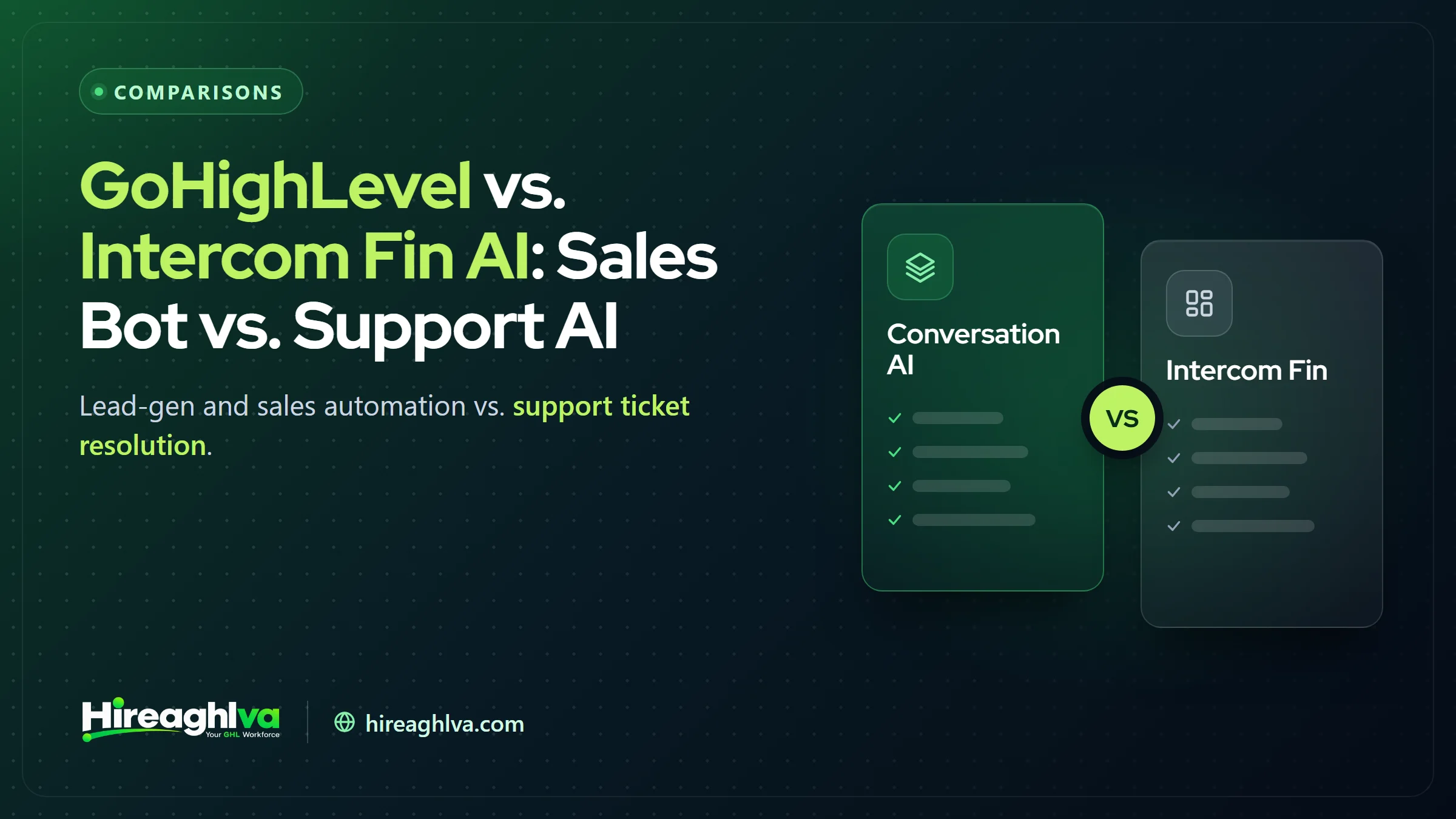
GoHighLevel Conversation AI is built for lead generation, qualification, and booking; Intercom Fin AI is built for customer support ticket resolution. Both use AI to handle inbound conversations — but they’re solving different problems. This comparison covers which fits which situation.
Of the AI chat comparisons in this series, this is the one most likely to get resolved with a single honest question rather than a long feature-by-feature evaluation: is the majority of your inbound conversation volume presales/booking inquiries, or post-sale support and troubleshooting? The rest of this guide fills in the detail, but that one question does most of the actual decision-making work for most businesses.
It’s also worth noting these two tools aren’t typically discovered by the same searcher for the same reason — someone comparing GoHighLevel against Intercom is usually either a service business wondering if Intercom’s support reputation means it’s worth considering more broadly, or a SaaS company already on GoHighLevel wondering if a dedicated support tool would serve their growing ticket volume better. This guide is written to serve both directions of that comparison.
Sales/lead-gen
GoHighLevel Conversation AI's core orientation
Support resolution
Intercom Fin AI's core orientation
Different jobs
This is a "which problem do you have" comparison, not "which is better"
What is the difference between GoHighLevel Conversation AI and Intercom Fin AI?
GoHighLevel Conversation AI is built to turn inbound inquiries into booked appointments and qualified leads, while Intercom Fin AI is built to resolve customer support tickets against a knowledge base. Conversation AI lives inside a broader CRM/funnel/scheduling platform, and its conversations are oriented toward moving a prospect toward a business outcome (a booking, a sale). Fin AI answers questions against a knowledge base, reducing the volume of tickets that need a human support agent, inside a platform purpose-built for help desk and customer support operations.
This isn’t really about which tool is “better” — it’s about whether your main problem is turning conversations into leads and sales (GoHighLevel’s strength) or resolving support tickets efficiently (Intercom’s strength). Trying to use either tool for the other’s core job generally produces a weaker result than using the tool built for that specific purpose.
Feature comparison
Core orientation
- GoHighLevel Conversation AI
- Lead-gen, qualification, booking
- Intercom Fin AI
- Support ticket resolution
Knowledge-base-driven resolution
- GoHighLevel Conversation AI
- Basic
- Intercom Fin AI
- Core specialty, deeply built out
Ticketing/help desk system
- GoHighLevel Conversation AI
- Intercom Fin AI
Native CRM/pipeline
- GoHighLevel Conversation AI
- Intercom Fin AI
Native scheduling/booking
- GoHighLevel Conversation AI
- Intercom Fin AI
Native funnels/landing pages
- GoHighLevel Conversation AI
- Intercom Fin AI
| GoHighLevel Conversation AI | Intercom Fin AI | |
|---|---|---|
| Core orientation | Lead-gen, qualification, booking | Support ticket resolution |
| Knowledge-base-driven resolution | Basic | Core specialty, deeply built out |
| Ticketing/help desk system | ||
| Native CRM/pipeline | ||
| Native scheduling/booking | ||
| Native funnels/landing pages |
Where Intercom Fin AI wins
Purpose-built support ticket resolution. Fin AI is specifically designed to resolve customer support questions against a structured knowledge base, with resolution-tracking and escalation-to-human-agent workflows that GoHighLevel’s more general-purpose Conversation AI doesn’t match in depth.
Mature help desk infrastructure. Ticketing, SLA tracking, support-agent collaboration tools — Intercom’s core product identity, built and refined specifically for support team operations over many years.
Better fit for SaaS/software companies with ongoing support volume. Software products generate a steady stream of “how do I…” and troubleshooting questions that Fin AI is specifically built to resolve efficiently against product documentation.
Where GoHighLevel Conversation AI wins
Native integration with lead capture and booking. A conversation that qualifies a lead can immediately book an appointment on the same platform’s calendar and update the same CRM record — no separate tool integration required.
Built for the full sales/service business workflow, not just the conversation. Conversation AI lives alongside funnels, SMS follow-up, and review management — the conversation is one step in a broader customer journey the platform handles end to end.
Better fit for local service businesses. A contractor, clinic, or salon’s primary AI-chat need is usually “convert this inquiry into a booked appointment” as fast as possible — the core idea behind speed-to-lead automation — which is GoHighLevel’s core strength — not “resolve this technical support ticket,” which is Intercom’s.
Team structure and who manages each tool
Intercom Fin AI is typically managed by a dedicated support team — support leads maintaining the knowledge base, monitoring resolution rates, and handling escalations that Fin AI couldn’t resolve. This assumes a business has (or is building) a genuine support function as a distinct operational area. GoHighLevel Conversation AI is typically managed by whoever owns marketing/sales operations (in-house, or a dedicated GoHighLevel VA) — configuring conversation flows to qualify leads effectively, monitoring booking conversion rates, and refining prompts based on what’s actually converting. These are different organizational functions with different skill sets, which is part of why a business genuinely needing both capabilities often has (or needs) two different internal owners for each tool, not one person managing both.
Escalation handling: what happens when AI can’t resolve it
Both platforms are designed to hand off to a human when the AI can’t adequately handle a conversation, but the escalation experience differs based on each platform’s core design. Intercom’s escalation flow is built around its ticketing system — an unresolved Fin AI conversation becomes a properly queued support ticket with full conversation history, assigned according to your support team’s existing routing rules. GoHighLevel’s escalation is generally simpler — a workflow can route an AI conversation that isn’t progressing toward a booking to a human team member’s notification or task queue, without the more formal ticketing/SLA infrastructure Intercom provides. For businesses with a genuine, structured support operation, Intercom’s more formal escalation handling is a real advantage; for businesses whose “escalation” is simply “have someone call this lead back,” GoHighLevel’s simpler approach is entirely sufficient and adds less overhead.
Which is better: GoHighLevel Conversation AI or Intercom Fin AI?
GoHighLevel is the better fit for booking-driven local service businesses and agencies managing client lead generation; Intercom Fin AI is the better fit for SaaS and software companies with ongoing support ticket volume.
SaaS/software company with support ticket volume
- Better fit
- Intercom Fin AI
- Why
- Purpose-built knowledge-base resolution
Local service business (booking-driven)
- Better fit
- GoHighLevel
- Why
- Native CRM/calendar integration for lead-to-booking flow
E-commerce with both sales inquiries and support
- Better fit
- Depends on ratio
- Why
- Whichever conversation type dominates your volume
Agency managing client lead-gen
- Better fit
- GoHighLevel
- Why
- Sales/booking orientation matches agency client needs
| Better fit | Why | |
|---|---|---|
| SaaS/software company with support ticket volume | Intercom Fin AI | Purpose-built knowledge-base resolution |
| Local service business (booking-driven) | GoHighLevel | Native CRM/calendar integration for lead-to-booking flow |
| E-commerce with both sales inquiries and support | Depends on ratio | Whichever conversation type dominates your volume |
| Agency managing client lead-gen | GoHighLevel | Sales/booking orientation matches agency client needs |
Setup and time-to-value comparison
Getting each platform to a genuinely useful state takes different kinds of effort. Intercom Fin AI’s time-to-value is directly gated by knowledge base quality — a business with existing, well-organized support documentation can often have Fin AI delivering meaningful resolution rates within days of setup, while a business starting from thin or nonexistent documentation faces weeks of documentation-writing work before the AI has enough material to resolve tickets reliably. GoHighLevel Conversation AI’s time-to-value is gated more by workflow configuration — connecting the AI to your calendar, defining qualifying questions, and setting appropriate escalation triggers, work that’s more about business-process mapping than documentation writing. Neither is inherently faster in the abstract; the deciding factor is usually which kind of prep work (documentation vs. process configuration) your business already has more of in place.
Data and privacy considerations for each use case
Support conversations handled by Intercom Fin AI often involve account-specific, sometimes sensitive information (billing details, account access issues), which is part of why Intercom’s platform includes support-industry-standard data handling and access-control features as a core part of its offering. GoHighLevel Conversation AI’s lead-qualification conversations more typically involve less sensitive information (contact details, service preferences, scheduling), though any business handling payment or health-adjacent information through either platform should independently verify the specific compliance requirements relevant to their industry (HIPAA for healthcare, PCI-DSS considerations for payment-adjacent conversations) rather than assuming either platform’s general-purpose data handling automatically satisfies industry-specific requirements.
How is Intercom Fin AI priced compared to GoHighLevel Conversation AI?
Intercom Fin AI is priced per resolved conversation, while GoHighLevel Conversation AI is priced on token-based pay-per-use or a flat $97/month Unlimited AI plan. The two platforms price their AI conversation handling on genuinely different bases, which reflects their different core purposes:
Pricing basis
- GoHighLevel Conversation AI
- Token-based pay-per-use, or $97/mo unlimited
- Intercom Fin AI
- Per resolved conversation
What triggers a charge
- GoHighLevel Conversation AI
- AI processing tokens consumed
- Intercom Fin AI
- A support conversation successfully resolved by AI
Predictability
- GoHighLevel Conversation AI
- Variable with token usage, or flat if Unlimited
- Intercom Fin AI
- Variable with resolution volume
What "success" looks like for pricing
- GoHighLevel Conversation AI
- Any AI-handled conversation, regardless of outcome
- Intercom Fin AI
- Specifically a resolved ticket — unresolved escalations may be priced differently
| GoHighLevel Conversation AI | Intercom Fin AI | |
|---|---|---|
| Pricing basis | Token-based pay-per-use, or $97/mo unlimited | Per resolved conversation |
| What triggers a charge | AI processing tokens consumed | A support conversation successfully resolved by AI |
| Predictability | Variable with token usage, or flat if Unlimited | Variable with resolution volume |
| What "success" looks like for pricing | Any AI-handled conversation, regardless of outcome | Specifically a resolved ticket — unresolved escalations may be priced differently |
Intercom’s resolution-based pricing directly aligns cost with value delivered for a support use case — you pay when the AI actually resolves something, not just for attempting to. This makes sense for support use cases where the whole point is deflecting tickets from human agents. GoHighLevel’s token-based pricing aligns more naturally with a sales/lead-gen use case, where the value isn’t necessarily a single binary “resolved” outcome — a qualifying conversation that doesn’t immediately book an appointment can still have real value (nurturing a lead, gathering information) even without a clean “resolution.”
Multi-channel coverage compared
Intercom Fin AI operates primarily within Intercom’s own chat widget and messaging channels — web chat, in-app messaging, and email, with the conversation experience centered on Intercom’s own interface embedded into your product or website. GoHighLevel Conversation AI operates across SMS, web chat, and integrated social channels, with the same AI logic applying regardless of which channel a contact reaches out through. This channel difference matters most for businesses where SMS specifically is a primary channel (and where the sending number needs A2P 10DLC registration) — a home services business fielding text-message inquiries, or recovering unanswered calls with missed call text-back, has no real Intercom equivalent for that specific channel, since Intercom’s strength is web/in-app chat rather than SMS-based conversation.
A worked cost example for each use case
Support-heavy business (SaaS company): 2,000 support conversations/month, and for the sake of the example, assume Fin AI resolves 60% of them without human intervention (1,200 resolutions) — your actual resolution rate depends on knowledge base quality. At Intercom’s resolution-based pricing, cost scales directly with that 1,200 resolved-conversation count — a genuinely different cost driver than GoHighLevel’s token-based model would apply to the same conversation volume, since GoHighLevel would charge for AI processing on all 2,000 attempted conversations regardless of resolution outcome.
Sales/booking-heavy business (local service company): 300 inbound inquiry conversations/month, mostly qualifying and booking-oriented. On GoHighLevel’s token-based pricing, cost scales with actual conversation length and complexity across all 300 conversations; on the $97/month Unlimited AI plan, this volume is very likely well within the flat-rate’s value threshold given it’s also usually bundled with other AI tools this business would use.
How each pricing model applies to the two worked examples above
| Worked example | Monthly conversation volume | Intercom Fin AI cost driver | GoHighLevel Conversation AI cost driver |
|---|---|---|---|
| Support-heavy SaaS company | 2,000 (assumed 60%, or 1,200, resolved by AI) | Per resolution — 1,200 resolved conversations | Tokens across all 2,000 attempted conversations |
| Booking-heavy local service company | 300 qualifying and booking inquiries | Not modeled — booking conversations rarely have a binary "resolved" outcome | Tokens across all 300, or very likely within the $97/mo Unlimited AI plan |
| Item | Value |
|---|---|
| GoHighLevel Conversation AI (all AI-processed conversations) | 2000 |
| Intercom Fin AI (resolved conversations only) | 1200 |
These two examples illustrate why direct pricing model comparison is less useful than understanding which cost structure matches your actual conversation pattern — a support-ticket-heavy business benefits from paying per successful resolution; a qualification/booking-heavy business benefits from a token or flat-rate model that doesn’t require a binary “resolved” outcome to have delivered value.
What each platform requires to work well
Intercom Fin AI’s effectiveness depends heavily on knowledge base quality. Fin AI resolves tickets by referencing your support documentation — a thin, outdated, or poorly organized knowledge base directly limits how many tickets it can successfully resolve, regardless of the underlying AI’s capability. Businesses considering Fin AI should honestly assess their documentation maturity before assuming high resolution rates.
GoHighLevel Conversation AI’s effectiveness depends more on workflow and prompt configuration. Since it’s oriented toward guiding a conversation toward a specific outcome (booking, qualification) rather than referencing a static knowledge base, its performance depends more on how well the conversation flow and AI prompts are configured for your specific business’s typical inquiries — the same calendar, pipeline, and escalation wiring covered in our GoHighLevel automation build-outs.
If you’re evaluating Intercom Fin AI specifically, audit your existing support documentation honestly before committing — a business with thin documentation will see disappointing resolution rates regardless of platform choice, and that gap needs addressing (writing more complete docs) independent of which AI tool you choose.
Hybrid businesses: when you genuinely need both types of conversation handling
Some businesses — particularly SaaS companies with both a sales funnel and an ongoing support need — genuinely have both problems simultaneously: converting trial sign-ups into paying customers (a GoHighLevel-style sales/booking problem) and resolving product support questions from existing customers (an Intercom-style support problem). For these businesses, running both platforms for their respective specialties, with lead/customer data synced between them via integration (a common scope for custom GoHighLevel software builds), is a legitimate pattern — though it’s worth being honest about whether your business genuinely has both distinct conversation types at meaningful volume, or whether one clearly dominates and a single platform would serve the majority use case well enough without the added complexity of running two systems.
Industry patterns: who chooses which
Intercom Fin AI tends to attract: SaaS and software companies, digital product businesses with self-service usage models generating recurring “how do I…” questions, and any business where post-purchase support volume is a significant, ongoing operational cost center.
GoHighLevel Conversation AI tends to attract: local and regional service businesses (contractors, medical/dental, legal, real estate) whose primary conversation need is converting inquiries into bookings, and agencies managing lead generation for multiple clients.
Frequently asked comparison questions
“Can GoHighLevel’s Conversation AI reference a knowledge base the way Intercom’s Fin AI does?” GoHighLevel’s Conversation AI can be configured with business-specific information and FAQ content to draw from, but it isn’t built around a dedicated, structured knowledge-base-and-ticketing system the way Intercom’s support-first architecture is — the underlying capability differs in depth and purpose, not just in degree.
“Does Intercom have anything like GoHighLevel’s Voice AI for phone calls?” Intercom’s core product is chat/messaging-based rather than voice-call-based — if phone/voice AI handling is a requirement, that’s a point clearly in GoHighLevel’s favor, since Intercom isn’t built around voice call handling in the way it’s built around chat-based support. (Our GoHighLevel Voice AI vs. Bland, Retell, Synthflow & Vapi comparison covers the voice side in depth.)
“Which platform is easier to set up for a small team?” Both require real configuration to work well — Intercom needs a solid knowledge base built out; GoHighLevel needs conversation flows and CRM structure configured. Neither is instantly plug-and-play, though GoHighLevel’s setup work pays off across a broader set of business functions beyond just chat.
Bringing it together
Intercom Fin AI wins for businesses whose primary AI-chat need is resolving customer support tickets efficiently — particularly SaaS and software companies with ongoing product-support volume. GoHighLevel Conversation AI wins for businesses whose primary need is converting inbound inquiries into booked appointments and qualified leads, integrated into a broader CRM and business operations platform. The right choice comes down to which problem — support resolution or sales conversion — actually describes the majority of your inbound conversation volume.
If you’re a local service business reading this comparison, the answer is very likely GoHighLevel — support-ticket-style AI resolution against a knowledge base isn’t the shape of most service-business inbound conversations, which are overwhelmingly booking and inquiry-driven. If you’re a software company with a growing support ticket volume and a mature knowledge base, Intercom’s specialized resolution engine is worth the evaluation Intercom’s own trial process allows.
Written by the Hireaghlva GoHighLevel team
We build and run GoHighLevel accounts, automations, dashboards, and websites for agencies and local businesses across the US and Canada. This guide reflects that hands-on work, with sources cited inline where we reference outside data.