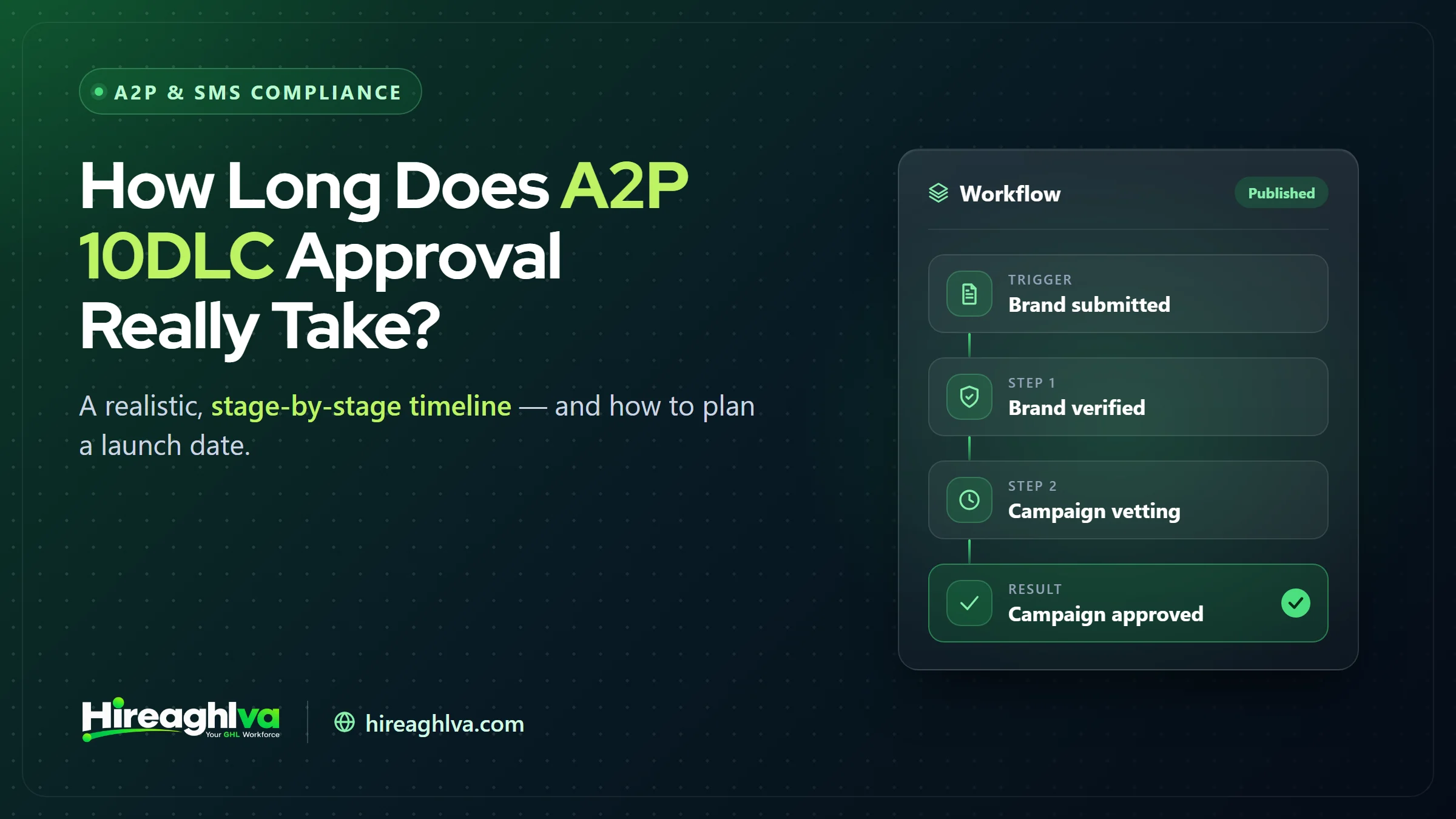
A2P 10DLC approval typically takes under a week for a clean, complete submission — Brand often within minutes, Campaign within roughly 1–5 business days. “How long will this take?” is one of the first questions anyone starting A2P 10DLC registration asks, and the honest answer is “it depends” — but it depends on a small, knowable set of factors, not on luck. This guide gives you a realistic, stage-by-stage timeline and the specific things that push it longer, so you can plan a launch date with actual confidence.
Part of what makes this question hard to answer from a quick search is that the available information genuinely conflicts — some sources promise near-instant approval, others warn of month-long ordeals, and neither framing gives you enough to actually plan around. This guide breaks the process into its real, distinct stages, explains what drives each stage’s duration, and gives you planning guidance based on the actual mechanics rather than a single, oversimplified number.
Minutes
Typical Brand approval time for a clean, accurate submission
1–5 days
Typical Campaign approval window for a well-prepared submission
2–4+ weeks
Realistic total if a rejection-and-resubmission cycle or manual review is involved
How long does A2P 10DLC approval take for a clean submission?
A clean A2P 10DLC submission typically takes under a week from start to a fully working, tested setup: Brand approved same-day, Campaign approved within roughly 1–5 business days.
| Item | Value |
|---|---|
| Brand review | 0.5 days |
| Campaign review | 3 days |
| Number linking + testing | 0.5 days |
For a submission with accurate legal details, a live business website, specific sample messages, and a clearly described opt-in method, the realistic timeline looks like: Brand approved same-day (often within minutes), Campaign submitted immediately after and approved within roughly 1–5 business days, and number linking plus test-message verification completed within the same day approval comes through. Total: typically under a week from start to a fully working, tested setup.
Even faster: the Chat Widget (Pre-Built) Campaign path
There’s now a genuinely faster option worth knowing about specifically for timeline purposes. GoHighLevel’s Chat Widget (Pre-Built) Campaign registration — which auto-generates your disclosure language and sample messages in exchange for making the chat widget your only SMS opt-in method — carries a shorter stated approval window than Manual Setup.
<48 hrs
GoHighLevel-stated average approval for widget-first Campaign submissions
~2–4 days
More conservative real-world estimate worth planning around
The mechanism behind the speed is straightforward: locked, pre-approved disclosure language removes most of the ambiguity that normally sends a Campaign into a slower, more judgment-intensive manual review (HighLevel Support, Pre-Built A2P Campaign Registration with Chat Widget). Brand approval timing is unaffected either way — this speed advantage applies specifically to the Campaign step.
This faster timeline only applies if the chat widget can be your only SMS consent point — any SMS consent checkbox left on another form on your site has to go, and the disclosure language is locked. Brand type and message type are no longer blockers: the widget flow supports Sole Proprietor accounts as well as Standard brands, and Marketing/Promotional, Transactional, or Mixed messaging, with the use case set automatically (HighLevel changelog). If a single consent point doesn’t work for your site, plan around the Manual Setup timeline above instead — our step-by-step guide to submitting A2P 10DLC in GoHighLevel covers both paths in full.
What makes A2P 10DLC approval take longer?
A2P 10DLC approval takes longer mainly because of rejection-and-resubmission cycles, Campaigns flagged for manual carrier review, and incomplete submissions that stall before review even begins.
One rejection-and-resubmission cycle
- Factor
- Another full 1–5 business day review, plus your fix time
Campaign flagged for manual carrier review
- Factor
- Add 1–2+ weeks, less predictable
Incomplete submission (missing required info)
- Factor
- Delay starts before review even begins
Slow internal turnaround gathering business details
- Factor
- Entirely within your control — plan ahead
| Factor | Typical added delay | |
|---|---|---|
| One rejection-and-resubmission cycle | Another full 1–5 business day review, plus your fix time | |
| Campaign flagged for manual carrier review | Add 1–2+ weeks, less predictable | |
| Incomplete submission (missing required info) | Delay starts before review even begins | |
| Slow internal turnaround gathering business details | Entirely within your control — plan ahead |
The single biggest lever over your own timeline isn’t anything carrier-side — it’s whether your first submission is complete and accurate. A rejection doesn’t just cost the time to fix and resubmit; it costs an entire additional review cycle, which is often the same length as the original review. Our guide to every A2P registration rejection reason and its exact fix is specifically designed to prevent this.
A realistic day-by-day plan
Day 0
Gather all business details; submit Brand registration same day
Day 0–1
Brand approved (often within minutes to hours)
Day 1
Submit Campaign registration immediately once Brand clears
Day 2–6
Campaign under review — typical approval window
Day 6–7
Link approved campaign to number; send test messages
If you’re planning a launch date, working backward from this timeline with a buffer is the right approach: start registration at least 2–3 weeks before any hard launch date, which comfortably absorbs one rejection cycle without threatening the launch.
This buffer recommendation isn’t overly conservative padding — it’s calibrated specifically against the realistic worst-case scenario covered in the reference table further down this guide, not an arbitrary round number. A shorter buffer works fine for a soft launch date you can flex if needed; a genuinely hard, externally-committed launch date deserves the full 2–3 week runway.
A complete timeline reference table
Bringing every stage covered in this guide together into one reference:
Brand review
- Best case
- Minutes
- Typical
- Same day
- Worst case
- 1–3 business days
Campaign review (clean, Manual Setup)
- Best case
- 1 business day
- Typical
- 1–5 business days
- Worst case
- 5–10 business days
Campaign review (Chat Widget path, widget as only opt-in)
- Best case
- Under 48 hrs
- Typical
- ~2–4 days
- Worst case
- 4–5 days
Campaign review (with 1 rejection cycle)
- Best case
- N/A
- Typical
- +3–7 business days
- Worst case
- +2+ weeks
Number linking + testing
- Best case
- Minutes
- Typical
- Same day
- Worst case
- 1 business day
Total, clean submission
- Best case
- ~1–2 days
- Typical
- ~1 week
- Worst case
- ~2 weeks
Total, with a rejection cycle
- Best case
- ~1 week
- Typical
- ~2–3 weeks
- Worst case
- 4–6+ weeks
| Best case | Typical | Worst case | |
|---|---|---|---|
| Brand review | Minutes | Same day | 1–3 business days |
| Campaign review (clean, Manual Setup) | 1 business day | 1–5 business days | 5–10 business days |
| Campaign review (Chat Widget path, widget as only opt-in) | Under 48 hrs | ~2–4 days | 4–5 days |
| Campaign review (with 1 rejection cycle) | N/A | +3–7 business days | +2+ weeks |
| Number linking + testing | Minutes | Same day | 1 business day |
| Total, clean submission | ~1–2 days | ~1 week | ~2 weeks |
| Total, with a rejection cycle | ~1 week | ~2–3 weeks | 4–6+ weeks |
This table is the single most useful artifact in this guide for planning purposes — bookmark or screenshot it if you’re actively working through registration and want a quick reference without re-reading the full explanation each time.
Toll-free’s timeline, for comparison
Toll-free verification can be approved in as little as 2 days, though this isn’t guaranteed and can extend further if additional review is triggered — broadly comparable to, and sometimes faster than, A2P 10DLC’s typical window, though both paths can extend meaningfully if something is flagged. Our toll-free vs. A2P 10DLC comparison covers when the timeline difference is significant enough to actually influence which path you choose.
Why timeline estimates vary so much across different sources
If you’ve researched this topic and found wildly different numbers — some sources say “instant,” others say “6 weeks” — both can be technically accurate, describing different scenarios. “Instant” or “same-day” language usually describes Brand approval alone, or an optimistic best-case for the full process. “4–6 weeks” usually describes either a worst-case rejection cycle, or older data from earlier in A2P 10DLC’s rollout when carrier review infrastructure was less mature and processing volumes were different than they are now. Neither figure is wrong, but neither is a reliable single expectation to plan around either — the stage-by-stage breakdown in this guide is a more useful planning tool than any single headline number.
The real cost of an unbuffered timeline
It’s worth being concrete about why “just start early” is more than generic advice. A business that starts A2P 10DLC registration the day before a planned SMS campaign launch, assuming the “typical” fast-path timeline will hold, is making a bet with real downside: if that specific submission happens to need one round of correction — a common enough outcome even for careful registrants — the launch either slips by a week or more, or the business is tempted to launch on an unapproved number and face outright delivery blocking.
Compare that to a business that starts registration three weeks ahead: even in the plausible worst case (one rejection cycle plus a few days of manual review), there’s still comfortable margin before launch, and in the common case (clean, fast approval), the extra buffer simply goes unused rather than costing anything. The asymmetry here strongly favors starting early — the downside of an unused buffer is nothing; the downside of an insufficient one is a blocked or delayed launch.
What GoHighLevel or Twilio support can (and can’t) do about timeline
It’s worth setting accurate expectations about support’s role here (whether you registered through GoHighLevel or followed our Twilio A2P 10DLC registration walkthrough), since a common instinct when a registration feels slow is to escalate to support hoping for expedited processing. Support can: confirm your submission actually went through and is in an active review state; clarify an unclear or ambiguous rejection reason; and escalate a submission that appears genuinely stuck well past the typical window. Support generally cannot: expedite standard review timing through a support request alone, override or bypass the underlying carrier/registry review process, or provide a specific completion date/time for a submission still in the standard review window. Understanding this distinction helps set the right expectation for what a support conversation can actually accomplish versus what it can’t, going into that conversation.
Seasonal and volume-driven timeline variation
Review timelines aren’t perfectly constant year-round — periods of unusually high registration volume across the industry (a regulatory deadline driving a wave of last-minute registrations, for example, as happened around the February 2025 enforcement date) can temporarily extend typical review windows industry-wide, independent of anything about your specific submission. If you’re registering during a period you know or suspect involves elevated industry-wide volume, building in extra buffer beyond the “typical” estimates in this guide is a reasonable precaution, even though there’s no way to predict these periods with certainty in advance.
What you can do while waiting
Registration review time doesn’t have to be dead time. While Brand or Campaign approval is pending, you can: build and test GoHighLevel SMS workflow automations using a personal number or internal test contacts (only sending to real customer numbers is blocked pre-approval, not workflow construction itself); finalize your business website, privacy policy, and opt-in flow if any of those aren’t fully polished yet; and prepare your contact list and any planned initial send content, so you’re ready to go the moment approval and number-linking are both complete rather than starting that work only after registration clears.
What’s actually happening during each review stage
Understanding what carriers are doing during the “pending” status makes the wait less opaque, and helps set realistic expectations for why one stage is faster than another.
During Brand review, the primary check is a data-matching process — cross-referencing your submitted legal name, EIN, and address against official business registration and tax records. This is largely automatable, which is why it’s often fast; a clean match against official records can clear in minutes because there’s little ambiguity for a reviewer (human or automated) to resolve.
During Campaign review, the process is more judgment-intensive — evaluating whether your declared use case, sample messages, and opt-in description are internally consistent, specific, and compliant with content restrictions. This requires more actual reading and evaluation than a data-matching check, which is the core reason it consistently takes longer than Brand review, even for equally well-prepared submissions.
During any secondary/manual review (triggered for certain business categories, unusually high requested volume, or ambiguous submissions), a human reviewer evaluates the submission more thoroughly, which is inherently less predictable in timing than automated matching or standard review.
What each A2P 10DLC review stage checks, and why its timing differs
| Review stage | What is checked | Why the timing is what it is |
|---|---|---|
| Brand review | Legal name, EIN, and address against official records | Largely automatable data match — often minutes |
| Campaign review | Use case, sample messages, and opt-in description for consistency and compliance | Judgment-intensive reading — typically 1–5 business days |
| Secondary / manual review | Certain business categories, high requested volume, or ambiguous submissions | Human reviewer — least predictable timing |
How the timeline has changed since A2P 10DLC’s rollout
A2P 10DLC as a system (explained in full in our complete guide to what A2P 10DLC is) has existed since 2021–2022, and its practical review timelines have generally improved as carrier and registry infrastructure matured. Early adopters in 2022 often reported longer, less predictable review windows — partly due to registry-side growing pains, partly due to less mature guidance on what a “clean” submission actually looked like. By 2026, with several years of established process and much clearer public guidance (including everything covered in this series), the realistic timeline for a well-prepared submission is meaningfully more predictable and generally faster than it was in the system’s first year or two. This matters mainly because if you encounter older articles, forum posts, or anecdotes describing multi-week ordeals, they may reflect that earlier, rougher period rather than current typical experience.
Timeline expectations by business type
Established local business, EIN, Standard brand
- Typical timeline
- Under a week, clean submission
- Why
- Straightforward data match, low-scrutiny use case
Sole Proprietor, no EIN
- Typical timeline
- Similar, under a week
- Why
- Simpler brand type, though public-email-domain errors are common
Financial services / restricted categories
- Typical timeline
- Longer, more uncertain
- Why
- Higher scrutiny, possible additional manual review
Franchise/multi-location under one parent brand
- Typical timeline
- Variable per location
- Why
- Each sub-account/location registers independently
| Typical timeline | Why | |
|---|---|---|
| Established local business, EIN, Standard brand | Under a week, clean submission | Straightforward data match, low-scrutiny use case |
| Sole Proprietor, no EIN | Similar, under a week | Simpler brand type, though public-email-domain errors are common |
| Financial services / restricted categories | Longer, more uncertain | Higher scrutiny, possible additional manual review |
| Franchise/multi-location under one parent brand | Variable per location | Each sub-account/location registers independently |
If you’re registering without an EIN, our Sole Proprietor A2P registration guide covers the public-email-domain requirement and the other details that keep that path under a week.
What should you do if an A2P 10DLC submission is stuck in Pending?
If an A2P 10DLC Campaign sits in Pending for more than 10 business days with no rejection notice, check for a missed follow-up request, confirm the submission actually went through, then contact GoHighLevel or Twilio support.
If your Brand or Campaign has been sitting in “Pending” status well beyond the typical window (say, more than 10 business days for a Campaign with no rejection notice), a few things are worth checking before assuming something is broken: confirm you haven’t missed a follow-up request for additional information, which can sit unanswered if it arrived via an email address you don’t check regularly; verify the submission genuinely went through and isn’t sitting in a draft or incomplete state that never actually triggered review; and if both check out, contacting GoHighLevel or Twilio support directly for a status update is a reasonable next step rather than continuing to wait indefinitely without visibility.
A genuinely stuck submission — not rejected, not approved, sitting well past the typical window with no communication — is uncommon but not unheard of. Support escalation resolves this faster than repeated waiting, since it puts a human on confirming whether the submission is actually in an active review queue or has stalled for a technical reason.
Planning timelines across multiple client sub-accounts
Agencies registering A2P 10DLC for several clients simultaneously — whether in-house or through a GoHighLevel virtual assistant — should plan for review timelines to run independently per sub-account rather than assuming a batch effect — approving five client campaigns doesn’t happen faster or slower as a group than approving them individually, since each is reviewed on its own by the registry. The practical planning implication: stagger client launch dates realistically based on when each registration was actually submitted, not based on an assumption that “we’re already familiar with this process now” will speed up review for the fifth client the way it might speed up your own internal submission process.
Frequently asked timeline questions
“Does resubmitting a rejected campaign go through a full new review, or an expedited one?” It goes through standard review again, generally not an expedited path — which is exactly why getting the submission right the first time matters more than treating resubmission as a quick, low-cost do-over.
“If I submit late on a Friday, does the weekend count against the review window?” Review timelines are generally expressed in business days, so weekends typically don’t advance the countdown — submitting Friday afternoon effectively starts your review clock the following Monday in practice, even if the system shows the submission timestamp as Friday.
“Can I check an estimated queue position or review progress anywhere?” No — there’s no public queue-position or progress-percentage indicator for A2P 10DLC review. Trust Center shows only the current status (Pending, Approved, Rejected), not granular progress within the Pending state.
Bringing it together
A2P 10DLC approval, for a clean and complete submission, realistically takes under a week — Brand often within minutes, Campaign within a handful of business days. The wide “weeks” estimates you’ll see elsewhere almost always describe a rejection cycle or manual review flag, not the standard path. Submit a complete, accurate registration the first time, build in a 2–3 week buffer before any hard launch date as insurance, and use the waiting period productively rather than treating it as time lost.
The single most useful mental model to carry away from this guide: treat the “typical” fast-path timeline as your working expectation for planning day-to-day tasks, but treat the “worst-case” timeline as your actual buffer for anything with a hard deadline attached. Businesses that plan around the optimistic number and get unlucky with a rejection are the ones who end up frustrated with “how long this takes” — businesses that plan around the realistic buffer rarely notice the timeline as a problem at all, since the buffer absorbs the variance the process genuinely has.
Written by the Hireaghlva GoHighLevel team
We build and run GoHighLevel accounts, automations, dashboards, and websites for agencies and local businesses across the US and Canada. This guide reflects that hands-on work, with sources cited inline where we reference outside data.