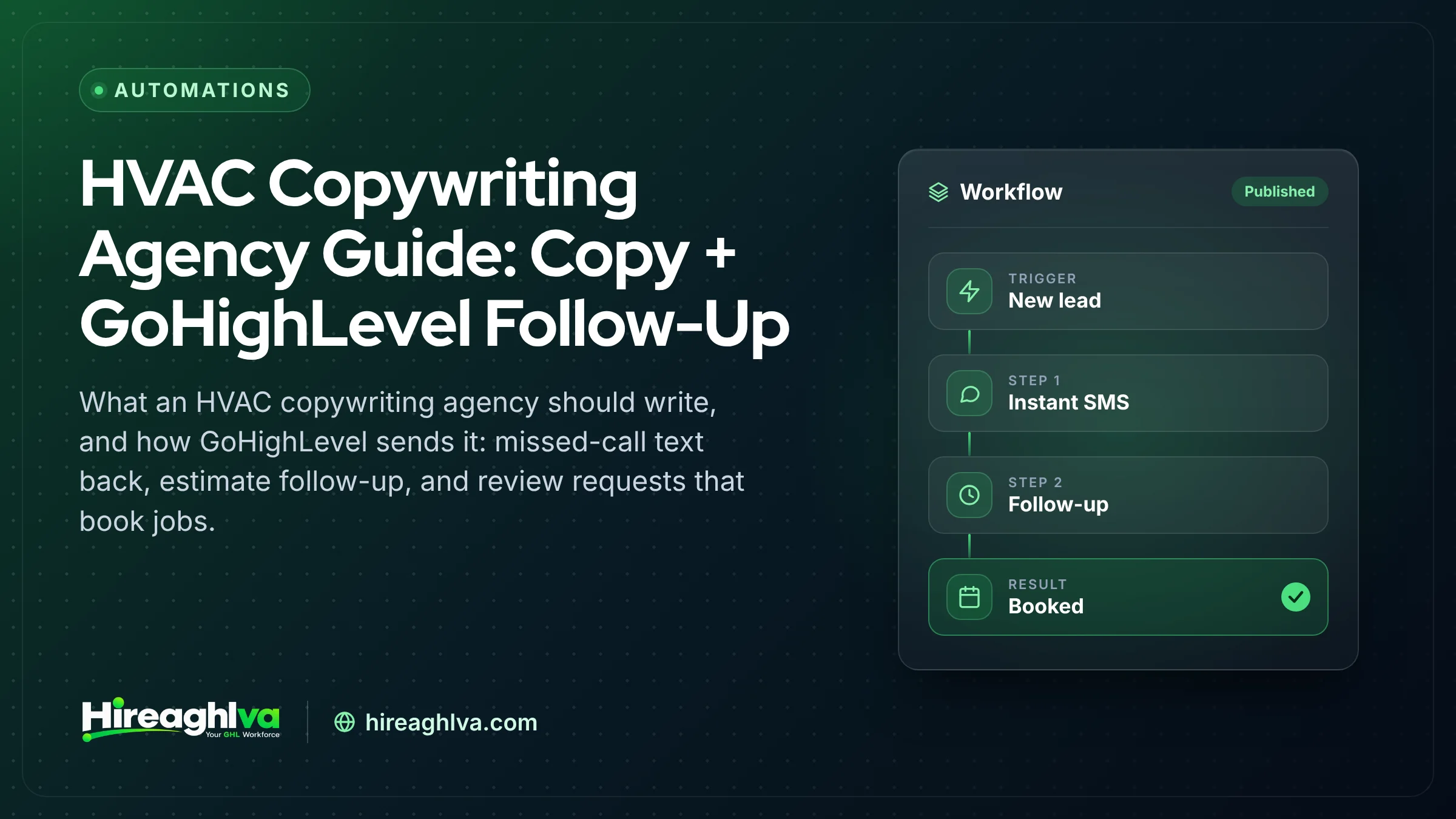
An HVAC copywriting agency writes the words that turn a homeowner’s search or phone call into a booked job: service pages, ads, and the short follow-up messages customers read on their phones. Of those, the follow-up copy usually matters most, because it lands at the exact moment someone decides who to hire. GoHighLevel is the system that sends that copy automatically, at the right time, to the right person.
Most HVAC owners who search for a copywriting agency are really trying to fix a leak further down the funnel. The website gets visits, the phone rings, estimates go out, and still too many jobs go to a competitor. Better headlines rarely fix that. What fixes it is having the right message ready for every moment that matters, and a reliable way to send it. This guide covers both: what to write, and how to wire it into GoHighLevel so it actually goes out, with notes for Houston HVAC companies where the local rules and climate change the details.
Definitions: HVAC copywriting is marketing and sales writing for heating, ventilation, and air conditioning companies. GoHighLevel (also called HighLevel or GHL) is an all-in-one CRM and marketing platform that handles calls, texts, email, pipelines, calendars, and review requests. Follow-up copy is the set of short, pre-written messages a CRM sends after a lead, call, estimate, or job.
What does an HVAC copywriting agency actually write?
The phrase covers a wider range of work than most owners expect. When you compare agencies, sort what they write into three layers, because each layer has a different job and a different person who should own it.
Layer 1: Attraction copy. This is what brings a homeowner to you: website service pages, city and service-area pages, Google Business Profile descriptions, paid search ads, social ads, and seasonal promotions. Its job is to match what people type when something breaks (“AC blowing warm air,” “furnace short cycling”) and to make calling you feel like the obvious next step.
Layer 2: Conversion copy. This is the copy on the page or in the call that turns interest into a booked visit: calls to action, booking forms, financing explanations, emergency-service banners, phone scripts, and the confirmation text a customer gets after booking. Its job is to remove friction and doubt.
Layer 3: Follow-up copy. This is everything that happens after first contact: the text a caller gets when you miss their call, appointment reminders, the thank-you after an estimate, the follow-up sequence for open replacement quotes, the post-job review request, and maintenance-plan renewal messages. Its job is to keep a lead from going cold and to turn a finished job into a review and a repeat customer.
Most agency portfolios lean heavily on Layer 1. That’s the visible work, and it’s what shows up in screenshots. But Layer 3 is where many HVAC companies lose the most revenue, because the follow-up copy either doesn’t exist, was written once years ago and never updated, or sits in a template nobody sends consistently.
Why do HVAC leads go cold, even with good marketing?
To fix the problem you have to name the cause precisely. In HVAC, lost leads usually come from a handful of structural issues, not weak headlines.
Demand arrives in surges. The first real heat wave of the summer and the first hard freeze of winter both flood phone lines at once. Those are also the days technicians are busiest, dispatchers are overwhelmed, and the owner is on a roof. Calls go to voicemail at the moment demand is highest.
Emergency and planned buyers behave differently. A homeowner with no cooling on a hot afternoon wants the first competent company that can come today. A homeowner planning a system replacement collects multiple quotes, talks it over at home, and may take weeks. One generic follow-up message can’t serve both, yet many CRMs run exactly one.
Replacement estimates are big decisions. A full system replacement is one of the larger purchases a household makes. People stall over cost, financing, and which equipment tier to choose. Without follow-up that answers those questions, the quote quietly dies, or the homeowner signs with whoever called back last.
After-hours contact is common. Many HVAC problems are noticed in the evening, when people get home to a hot or cold house. If nothing responds until morning, someone else may already have the job.
Nobody owns the system. Follow-up depends on a lot of small moving parts: a phone number connected to the CRM, a workflow that fires on the right trigger, templates that still match current pricing and offers, and pipeline stages someone actually updates. When nobody owns those parts, they break silently. The speed-to-lead guide covers why response time is so decisive once a lead arrives.
Put plainly: the best attraction copy in the world can’t save a lead that hears nothing back. That’s why follow-up copy and the system that sends it should be the first thing you fix.
Which HVAC copy matters most, and who should own it?
Here’s a practical map of the copy an HVAC company needs, where it lives, and who should realistically write and maintain it.
HVAC copy assets: where they live and who should own them
| Copy asset | Where it lives | Who writes it | Who maintains it |
|---|---|---|---|
| Missed-call text back message | GoHighLevel phone settings or workflow | Owner or copywriter, approved by owner | GHL specialist |
| After-hours auto-reply | GoHighLevel workflow | Owner or copywriter | GHL specialist |
| Appointment confirmation and reminders | GoHighLevel calendar notifications | GHL specialist from approved wording | GHL specialist |
| Replacement estimate follow-up sequence | GoHighLevel pipeline workflow | Copywriter with sales input | GHL specialist |
| Post-job review request | GoHighLevel reputation and workflow | Owner or copywriter | GHL specialist |
| Maintenance plan renewal and tune-up reminders | GoHighLevel workflow | Copywriter | GHL specialist |
| Service and city pages | Website | Copywriter | Web team |
| Paid search and social ads | Ad platforms | Copywriter or ad specialist | Ad specialist |
Notice the pattern. Writing the words is a short, occasional task. Keeping them firing correctly, updated, and connected to the right triggers is ongoing work. Agencies are usually hired for the first part and rarely do the second, which is why so many HVAC companies own a nice set of templates that nobody’s system actually sends.
How does missed-call text back work for an HVAC company?
Missed-call text back is a GoHighLevel feature that automatically sends a text message to someone whose call went unanswered. HighLevel’s own help center explains where to configure the missed call text back feature in the phone system settings. For HVAC, it’s usually the single fastest win, because missed calls are common during surges and on-site work.
Here’s what a good setup does, step by step:
- The call comes in to a GoHighLevel-connected number. Your website, Google Business Profile, and ads should all point to tracked numbers in the account, or the system never sees the call.
- The call goes unanswered. It might ring through to staff first, or route to voicemail after hours.
- A text goes out within moments. The message acknowledges the call, says who you are, and asks one simple question that makes replying easy.
- The reply lands in the shared inbox. Staff, an AI agent, or an on-call dispatcher sees it and responds. A workflow can also tag the contact and create an opportunity in the pipeline.
- The conversation moves to booking. The goal of the reply is a scheduled visit or a callback at a specific time, not an open-ended chat.
The copy itself should be short, specific, and human. Compare these two:
- Weak: “Sorry we missed your call! We’ll get back to you ASAP.”
- Stronger: “Hi, this is [Company] Heating & Air. Sorry we missed you. Is this about a system that’s not working right now, or about scheduling service? Reply here and we’ll help.”
The stronger version names the business, sorts emergency from non-emergency with one question, and invites a reply. That sorting question matters: it lets your team or your workflow route a “no cooling” reply to the on-call tech immediately while scheduling routine maintenance normally.
For the full setup, troubleshooting, and the landline caveats, see our GoHighLevel missed call text-back guide. If you want calls answered rather than texted back, an AI receptionist can pick up, answer common questions, and book appointments around the clock.
Texting rules apply. Business texting in the US generally requires A2P 10DLC registration for local numbers, and marketing messages need proper consent. Keep follow-up messages tied to the customer’s own inquiry, include opt-out language where required, and review your setup against our A2P opt-in compliance checklist. The FCC’s consumer guidance on robocalls and robotexts is a useful background read.
How should HVAC companies follow up on estimates?
A replacement estimate is the most valuable lead in your pipeline and often the most neglected. A common pattern is one follow-up call, then silence. Good estimate follow-up copy answers the questions homeowners actually stall on, spaced out so it helps rather than nags.
Here’s an example cadence for a replacement estimate. Treat the timing as a starting point to test, not a rule.
Example replacement estimate follow-up sequence (adjust to your sales cycle)
| When | Channel | Purpose of the copy |
|---|---|---|
| Same day | Text + email | Thank them, send the estimate, name the tech or comfort advisor, invite questions |
| Day 2 | Text | Answer the most common objection: monthly payment and financing options |
| Day 5 | Explain the difference between the equipment options in plain language | |
| Day 9 | Call task for staff | A real person checks in and offers to adjust the quote |
| Day 14 | Text | Simple yes/no: still deciding, already chose someone, or want to talk? |
| Day 30+ | Long-term nurture | Seasonal maintenance tips and offers, not hard selling |
The copy rules that make this work:
- One idea per message. A text that tries to cover financing, warranty, and scheduling at once gets skimmed. Spread them across touches.
- Talk about the decision, not the product. Homeowners care about comfort, reliability, monthly cost, and disruption to their week more than model numbers.
- Show the monthly payment where financing is offered. A total replacement price is easier to evaluate next to a realistic monthly option. Only quote terms your financing partner actually offers.
- Respect stop signals. Pause when the customer names a decision date. Stop when they book, decline, choose another provider, or ask you to stop. In GoHighLevel, build this with pipeline stages and workflow goals, so moving the opportunity to “Won” or “Lost” ends the sequence automatically.
- Hand off to a human. Automation keeps the deal warm. A real conversation usually closes it, so include call tasks for your comfort advisor.
Lost estimates aren’t necessarily gone. Months later, a polite check-in can revive some of them, which is the idea behind database reactivation campaigns.
How do you ask for HVAC reviews without breaking Google’s rules?
Reviews matter enormously in local service markets, and the review request is a short piece of copy with outsized impact. It also carries real policy risk if it’s written the wrong way.
Google’s policy on prohibited and restricted content for reviews doesn’t allow businesses to discourage negative reviews or to selectively ask only satisfied customers for them. That practice is often called review gating, and it shows up in plenty of off-the-shelf templates: “Were you happy? Click yes to leave a review, click no to tell us privately.” Building a flow where only “yes” clicks reach your public review page is the risky version. The US Federal Trade Commission has also taken a firm line on fake and manipulated reviews; its guidance on endorsements and reviews is worth reading before you run any review campaign.
A compliant, effective review request:
- Goes to every customer after a completed job, triggered automatically by a job or invoice status, not by someone’s judgment of who seemed happy.
- Is sent soon after the visit, while the experience is fresh, ideally the same day or the next.
- Names the technician. “Thanks for having Marcus out today” reads like a person, not a system, and reminds the customer who helped them.
- Gives one direct link to your Google review page. No extra clicks.
- Doesn’t offer an incentive in exchange for a review.
- Follows up once, a few days later, if there’s no response. Then it stops.
You can still offer a private feedback channel, such as a reply-to-this-text option for problems, as long as every customer also receives the public review link. And respond to every review, including the critical ones, calmly and specifically. Future customers read your replies as much as the reviews.
What’s different about HVAC marketing in Houston?
People searching for a Houston HVAC digital marketing agency or a Houston HVAC web design company have local conditions that should shape the copy. Swapping the city name into a generic template misses them.
A long, demanding cooling season. Houston’s hot, humid climate means air conditioning is close to essential for much of the year, and AC failures often feel urgent. Copy for Houston should treat “no cooling” as an emergency path, with same-day language, clear availability, and a fast route to a person. Humidity is part of the story too: homeowners notice sticky, clammy rooms, so copy that speaks to humidity control and indoor comfort, not just temperature, tends to match what they’re actually experiencing.
Storm season and outages. The Atlantic hurricane season, tracked by the National Hurricane Center, overlaps Houston’s hottest months. After major storms and power outages, demand for inspections and repairs can spike all at once. Pre-written storm-response templates, such as “We’re scheduling post-storm system checks; reply with your address and what you’re seeing,” save hours when your team has none to spare. Texas has also seen severe winter freezes, so heating and heat pump messaging shouldn’t be an afterthought.
State licensing and advertising rules. Air conditioning and refrigeration contractors in Texas are licensed by the Texas Department of Licensing and Regulation (TDLR). TDLR rules generally require contracting companies to include the license number in advertising designed to solicit business, with limited exceptions. In practice, that means your website footer, landing pages, ads, and any promotional templates should carry the number. Confirm the current rule text with TDLR or an attorney, because enforcement details and exceptions can change.
A large, competitive, multilingual market. Greater Houston is a sprawling metro with many HVAC companies competing on the same searches, and many households speak Spanish at home. If your team can serve Spanish-speaking customers, bilingual follow-up templates and a Spanish service page are real advantages, as long as the copy is written by a fluent speaker, not machine-translated and left unchecked.
Service area sprawl. A company based in one part of the metro may cover Sugar Land, The Woodlands, Pasadena, and beyond. Follow-up copy should set honest arrival expectations by area, and routing rules in GoHighLevel can assign leads to the right crew or location.
If your website itself needs work, our home contractor website packages are built for service-area businesses and connect directly to a GoHighLevel pipeline. Packages are $97, $197, or $397 per month, including hosting.
Step by step: building an HVAC follow-up system in GoHighLevel
Here’s the order we’d build it in, starting with the work that protects the most revenue soonest.
- Audit your entry points. List every place a lead can arrive: website forms, each tracked phone number, Google Business Profile messages, Facebook leads, and ad landing pages. Confirm each one actually creates a contact in GoHighLevel.
- Register for business texting. Complete A2P 10DLC registration before relying on texts, or messages may be filtered or blocked. Our guide on how to submit A2P 10DLC in GoHighLevel walks through it.
- Turn on missed-call text back with copy that sorts emergency from routine requests.
- Build the pipeline. Use simple, honest stages, for example: New lead, Contacted, Visit booked, Estimate sent, Won, Lost. Separate repair and replacement pipelines if your sales process differs.
- Add speed-to-lead for forms. New form leads get an immediate text and email plus an internal notification to whoever books jobs.
- Build the estimate follow-up workflow triggered by the “Estimate sent” stage, with a goal that exits the workflow when the opportunity moves to Won or Lost.
- Set up appointment confirmations and reminders from the calendar, including the technician’s name and arrival window.
- Automate review requests after job completion, sent to every customer, with one follow-up.
- Add seasonal campaigns. Spring cooling tune-ups and fall heating tune-ups for past customers and maintenance plan members.
- Test every path end to end with a test contact: call and hang up, submit each form, move a deal through each stage, and confirm every message fires once, with the right wording, at the right time.
- Document it. A one-page map of each workflow, its trigger, and its copy saves hours the next time something changes.
Much of this exists as a ready-made starting point. A prebuilt snapshot can import pipelines and workflows into a new account, which you then customize with your own copy. Our post on a prebuilt snapshot for Columbus home contractors shows what that looks like for trades businesses, and automations for Oklahoma City home contractors covers seasonal workflows in another hot-summer market.
HVAC copywriting agency, GHL VA, or do it yourself?
Most HVAC companies don’t need to choose just one. But it helps to be clear about what each option actually delivers.
Writes website, ad, and brand copy
- HVAC copywriting agency
- GoHighLevel VA
- Owner does it
- Sometimes
Drafts and loads follow-up templates you approve
- HVAC copywriting agency
- GoHighLevel VA
- Owner does it
Builds and tests GoHighLevel workflows
- HVAC copywriting agency
- Rarely
- GoHighLevel VA
- Owner does it
- If time allows
Maintains pipelines, triggers, and integrations
- HVAC copywriting agency
- GoHighLevel VA
- Owner does it
- Rarely
Fixes broken automations quickly
- HVAC copywriting agency
- GoHighLevel VA
- Owner does it
- Slowly
Ongoing reporting on leads and follow-up
- HVAC copywriting agency
- Sometimes
- GoHighLevel VA
- Owner does it
- Rarely
Typical engagement
- HVAC copywriting agency
- Project or retainer
- GoHighLevel VA
- Hourly or monthly plan
- Owner does it
- Unpaid owner hours
| HVAC copywriting agency | GoHighLevel VA | Owner does it | |
|---|---|---|---|
| Writes website, ad, and brand copy | Sometimes | ||
| Drafts and loads follow-up templates you approve | |||
| Builds and tests GoHighLevel workflows | Rarely | If time allows | |
| Maintains pipelines, triggers, and integrations | Rarely | ||
| Fixes broken automations quickly | Slowly | ||
| Ongoing reporting on leads and follow-up | Sometimes | Rarely | |
| Typical engagement | Project or retainer | Hourly or monthly plan | Unpaid owner hours |
A sensible split for many companies: use a copywriter for your website, service pages, and ad creative, and use a GoHighLevel specialist to own the system that delivers your follow-up. If you already have decent copy and the real problem is that it’s not being sent reliably, a GHL VA is the faster fix.
Here’s how our published VA pricing works out per hour of GoHighLevel time:
| Item | Value |
|---|---|
| Hourly / project work, starting rate ($/hr) | 20 |
| Part-time plan: $600 ÷ ~87 hrs ($/hr) | 6.9 |
| Full-time plan: $997 ÷ ~173 hrs ($/hr) | 5.76 |
Source: Derived from Hireaghlva published pricing, November 2026. Hours per month assume ~20 or ~40 hours a week across a typical month.
$20+/hr
Hourly or project-based GHL VA work
$600/mo
Part-time: ~20 hrs/week
$997/mo
Full-time: ~40 hrs/week
A one-time build of the core HVAC follow-up system fits hourly or project work. If you run seasonal campaigns, multiple locations, or a large volume of estimates, a part-time plan usually makes more sense, because the work never really ends: offers change, staff change, and workflows need tuning after every busy season. The pricing page compares all three options, and the automations service describes what we build.
How do you evaluate an HVAC copywriting agency or marketing vendor?
Whether you’re hiring a copywriter, a full-service HVAC marketing agency, or a GoHighLevel specialist, the same questions separate real expertise from a nice portfolio.
Questions to ask:
- “Show me follow-up copy you’ve written, not just websites.” Ask for missed-call texts, estimate sequences, and review requests, with client details removed.
- “How do you write differently for emergency repair and planned replacement leads?” A good answer distinguishes urgency, timing, and tone.
- “Who builds and tests the automations that send this copy?” If the answer is “your team,” make sure your team can.
- “How do you handle texting compliance?” Listen for A2P 10DLC registration, consent, and opt-out language.
- “How do you ask for reviews?” If they describe sending public review links only to happy customers, that’s a policy problem.
- “How will we know it’s working?” Expect specific measures: response time, estimate close rate, review volume, and booked jobs by source.
- “Who owns the accounts and assets if we part ways?” You should own your GoHighLevel account, phone numbers, domain, ad accounts, and copy.
Red flags:
- Guaranteed rankings, guaranteed review counts, or guaranteed lead numbers.
- Review-gating flows presented as “reputation protection.”
- Templates obviously reused across trades, with plumbing or roofing language left in.
- No mention of license number requirements for a Texas HVAC company.
- Every message written in the same hype-heavy tone, full of exclamation points and “limited time” pressure.
- Automations built inside the vendor’s own account instead of yours.
Common mistakes HVAC companies make with follow-up copy
These show up again and again when we audit HVAC accounts.
- One sequence for every lead. Emergency repair, maintenance, and replacement leads get identical messages. Split them by pipeline or tag.
- Templates that outlived their offers. A message still promoting last spring’s tune-up price, or a financing promotion that ended, erodes trust instantly. Review templates every season.
- Follow-up that never stops. Customers who already booked keep getting “Still thinking it over?” texts because workflow goals were never set. This is one of the fastest ways to look disorganized.
- No human in the loop. Automation sends messages, but nobody watches the replies. A customer answers “yes, today please” and hears nothing for hours.
- Writing like an ad instead of a person. Follow-up texts read like billboards. Short, plain, specific messages from a named person work better.
- Skipping texting registration. Messages get filtered, the team assumes they were delivered, and nobody notices for weeks. If texts seem to vanish, read about SMS carrier filtering in GoHighLevel.
- Untracked phone numbers. The number on the truck, the old yard signs, and the Google Business Profile all ring a line GoHighLevel never sees, so missed-call text back can’t fire.
- Review requests that depend on memory. “The tech will ask” means most customers are never asked. Trigger the request from a job status instead.
- Ignoring the off-season. Slow months are when you should be reactivating old estimates, selling maintenance plans, and fixing broken workflows before the next rush.
How do you know your HVAC follow-up is working?
Copy and automation are only worth what they produce. Track a few numbers monthly in a GoHighLevel dashboard rather than dozens.
- Missed calls and replies to missed-call texts. How many missed calls turned into a conversation, and how many of those booked.
- Speed to first response for form leads and text replies, during and outside business hours.
- Estimate close rate, separated by repair and replacement, and how many deals sat in “Estimate sent” for more than a few weeks.
- Review requests sent versus reviews received, and your average rating trend.
- Booked jobs by lead source, so you know which marketing spend actually produces work.
- Workflow errors, such as failed messages or contacts stuck in a step. Someone should check these weekly.
Compare each busy season with the last one, not with an industry average from a vendor’s blog. Your own trend is the honest measure. For broader visibility work, see our guide to local SEO for service businesses.
Bringing it together
An HVAC copywriting agency can make your company sound credible and help it get found. But the copy that most often decides whether you win the job is short and unglamorous: the text after a missed call, the follow-up after an estimate, and the review request after the visit. Write those messages carefully, ask every customer for a review the same way, follow your state’s advertising rules, and put the whole thing on a system that sends each message at the right moment and stops when it should.
If you’d rather have a specialist build and maintain that system, you can hire a dedicated GoHighLevel VA to set up missed-call text back, estimate follow-up, review requests, and seasonal campaigns, then keep them working through every heat wave and cold snap. If you’re a Houston HVAC company, start with our Houston page, or book a free scope call and we’ll map out what your follow-up should look like.
Written by the Hireaghlva GoHighLevel team
We build and run GoHighLevel accounts, automations, dashboards, and websites for agencies and local businesses across the US and Canada. This guide reflects that hands-on work, with sources cited inline where we reference outside data.